
Sailing from Lagos, Portugal into the Mediterranean
We’ve made it to the southern coast of Portugal last fall. Lagos has been good to us. We put S/V Spindrift up on the hard, got some needed maintenance done, had great food, and experienced the kind of lazy Atlantic swell that makes you forget what’s coming next. Spindrift goes back in the water tomorrow and we then need to reckon with the bottleneck: the Strait of Gibraltar and the Levante Trap!
What Is the Levante?
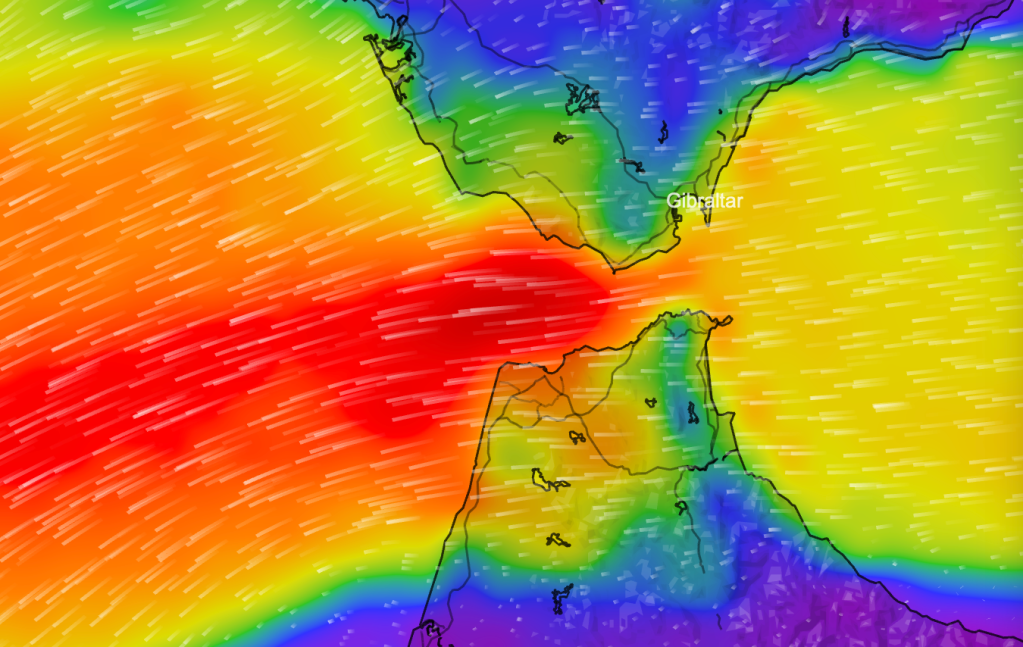
The Levante is a strong easterly wind that funnels through the Strait of Gibraltar, sometimes blowing 25 to 40 knots for days on end. It’s driven by pressure differences between the Atlantic and the Mediterranean, and the narrow gap between Europe and Africa acts like a venturi tube, accelerating the flow into something far more powerful than the synoptic charts might suggest.
For a boat heading east, which is exactly what we need to do, the Levante is a brick wall. You’re trying to push into a corridor barely eight miles wide at its narrowest, with a strong headwind, confused seas kicked up against the current, and commercial shipping bearing down on you from both directions. It’s not fun in these conditions. And it’s entirely avoidable if you have the one thing every sailor claims to have but rarely exercises: patience.
The Trap
Here’s where the name earns its keep. The Levante can blow for three, five, sometimes seven days straight. Crews get impatient. They see a brief lull on the forecast, motor out of port, and find themselves beating into 30 knots halfway through the Strait with a two-knot adverse current thrown in for good measure. That’s the Levante trap. The temptation to jump at the first hint of a break rather than waiting for a proper weather window.
We’ve heard the stories in every marina bar between La Rochelle to Lagos. Boats turning back. Boats sheltering behind Isla de las Palomas. Crews arriving in Gibraltar Marina swearing they’ll never do that again.
Waiting in Cadiz
So we’re not going to rush it. Our plan is to settle into Cadiz and wait for a Poniente. The westerly wind that periodically replaces the Levante and turns the Strait from an obstacle into a conveyor belt. With a Poniente blowing, the passage east becomes a dream run: fair wind, fair current, and you can be through the Strait and into the Alboran Sea in a matter of hours.
We hear that Cadiz is no hardship, either. The old town is said to be spectacular with narrow streets, tapas bars on every corner, and a pretty waterfront. If you have to be stuck somewhere waiting for weather, you could do a lot worse.
What the Forecast Looks Like Right Now
As of March 25th, the Strait is doing exactly what we don’t want, easterlies. Fresh ENE winds with gusts pushing into the high teens have the Strait locked up for anyone trying to head east. Patchy rain is moving through today and tonight, with temperatures sitting around 14–15°C, cool and damp, not exactly an invitation.
But here’s where it gets interesting. The models are showing a shift later in the week. By Thursday and Friday, the wind is forecast to swing WSW at 16–17 knots with gusts in the mid-20s. That’s a Poniente. If the models hold, that’s our window! A proper westerly push through the Strait with the current working in our favour. Saturday looks lighter still, with winds easing to around 10 knots, so there may be a two-day window opening up.
The forecast is still five days out, and the Strait has a way of making liars out of weather models. But after days of watching the wind arrows point stubbornly east, seeing them rotate west on the extended forecast is enough to sharpen the senses and start running through pre-departure checklists.
The good news is that the odds are in our favour regardless. The Poniente is actually more frequent than the Levante during the October-to-April sailing season, and March sits right in the heart of that window. Statistically, the westerlies dominate the cooler months. It’s the summer when the Levante really takes hold and can park itself over the Strait for weeks at a time. So while we’re waiting now, we’re waiting in the right season. The Poniente will come. It always does.
March is also the windiest month in Cadiz, averaging around 19 km/h, which means when the wind does swing west it tends to fill in with enough strength to give us a proper push through the Strait rather than leaving us motoring through a calm.
How We’re Reading the Weather
Forecasting a transit through the Strait isn’t a one-model job. The geography here, an eight-mile gap between two continents, creates local anomalies that the big global models don’t always capture. The Rock itself throws off katabatic winds, acceleration zones, and dramatic wind shifts that can make a forecast look wrong even when it’s technically right.
We love PredictWind. It gives eight leading models to compare plus as of late 2025, following a major update, they introduced new AI-driven options. So, we’re pulling models twice a day and comparing them. When they agree, we will trust the window. When they diverge, we wait. PredictWind is a wonderful tool.
The Plan
We’ll be watching the models and keeping an eye on the pressure gradient across the Strait. When the Levante finally breaks and the Poniente fills in from the west, we’ll pull the hook and make a smooth push eastward through the Strait and into the Med.
Until then another bottle of Portuguese wine on the plaza with my love, Sarah. There are worse ways to wait out the wind.
 S/V Spindrift
Leave a comment