
Getting Spindrift into the Med
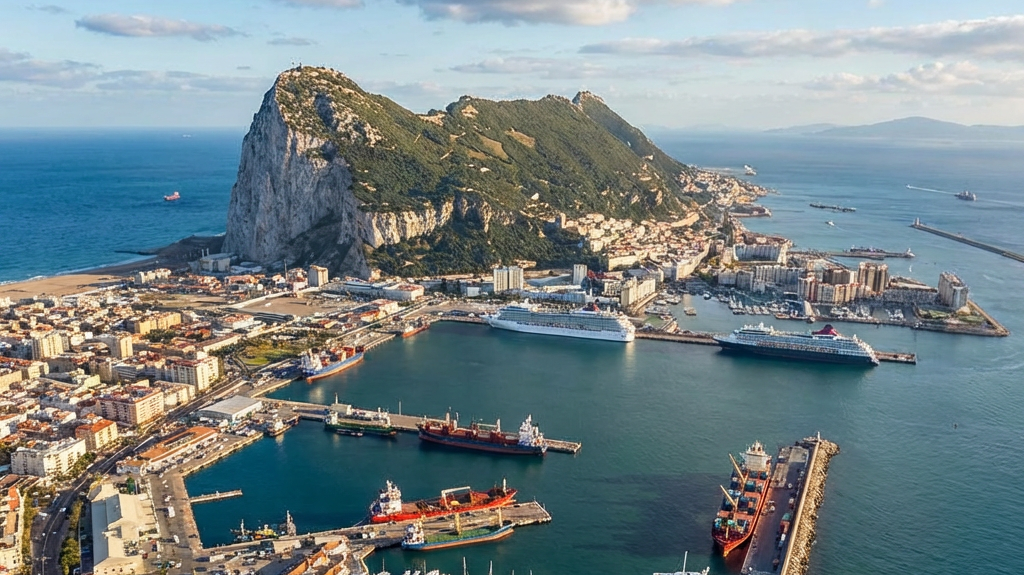
It’s 0835 local and I’m sitting in Alcaidesa Marina in Gibraltar with a cup of coffee. The Rock is right there, filling half the sky, and Spindrift is tied at the end of hammerhead dock. This post is mostly for Sarah and me, so we can remember the details of these last five days without having to dig through the ship’s log, which is handwritten and, frankly more clinical. Read on if you want. I won’t be offended if you pass. This is the first land we’ve touched since Lagos.
Getting There
We flew United from Newark to Lisbon on March 24th. Nothing glamorous just a long overnight coach flight and a longer drive on the other end. Lisbon to Lagos is about three hours by car, most of it on the A2 motorway through the Alentejo, watching the landscape as you head south. The storks are everywhere. Massive nests perched on top of church steeples, power poles, highway signs, anywhere with a flat surface and a view. They build these enormous stick condominiums and just stare down at you as you drive past. After a while you stop pointing them out.
By the time we hit the Algarve, we were tired. The GPS is leading you through an endless series of roundabouts that all look the same. After the third or fourth one you start to feel like you’re going in circles because you literally are. But we make it.
Lagos: Living on the Hard
Spindrift was waiting for us in the boatyard at Lagos, sitting on her keel like she’d been expecting us. We lived aboard while she was still on the hard. Climbing down the ladder every morning to take a shower and to do laundry. We now have folding bikes, so we had an easy bike ride into town for lunch, and slowly working through the commissioning list. We provisioned the boat while we still had the rental car, which is the only civilized way to do it. Try carrying two weeks of groceries on a bicycle and you’ll agree.
We did a number of minor repairs and inspected every system on the boat. Everything checked out. The one gap was a boom preventer. Spindrift didn’t have one, and we weren’t going offshore again without it. We worked with Antonio from FofoVelas Sails in Lagos. Wonderful guy. Snipe sailor. I think he said he was the Portuguese national champ in his younger days. If you’re in Lagos and need canvas or sail work, find him.
Launch Day — March 26
Spindrift went back in the water at 1800 on March 26th. There’s always a held breath when the slings release and she takes her own weight again. That moment when the hull settles and you’re floating, and everything you’ve been working on either works or it doesn’t. It all worked. We motored over to the visitors’ dock at the marina and spent two nights there, finishing up odds and ends, checking out of customs, and getting our heads right for the first passage.
Since we hold an extended-stay visa from France, our days in the Schengen area outside of French territory need to be counted separately from our days within France. At least one customs office told us that. If that sounds complicated, it is. We keep a spreadsheet. Ask me about it over a drink and watch my eyes glaze over.
Lagos to Faro — March 28
We slipped lines on the morning of March 28th and pointed east for Faro. About 45 nautical miles along the Algarve coast. The sail was beautiful, a steady 15 to 20 knots just forward of the beam, sunny and warm, the kind of day that reminds you why you do this. We carried full main and genoa almost the whole way, Spindrift heeled comfortably and ate up the miles. Toward the end of the afternoon the wind dropped out and we motored the last stretch, but nobody was complaining.
We arrived at the Barra de Faro-Olhão, an artificial inlet created in the 1950s. It’s one of six inlets into the Ria Formosa Natural Park. This is a sprawling system of barrier islands, tidal flats, and shallow channels that stretches along the Algarve coast. This inlet reminded us both of Barnegat Inlet back home in New Jersey. It has the same feel. Rock jetties with the open Atlantic on one side, and a protected waterway on the other. Oyster farms too. If you’ve run Barnegat, you know the drill.
We anchored the first night just inside the inlet. The next day we moved deeper into the waterway behind the barrier islands. Good call as we were expecting a blow from the northeast and wanted better protection. It came. A very strong northeast wind, gusting to 35 knots, howling through the anchorage for a full day. Spindrift held the bottom just fine. We didn’t leave the boat. Read books. Watched the gusts flatten the water and send spray off the chop. Sometimes the best sailing days are the ones where you don’t sail at all.
Faro to Puerto Sherry — March 31
We left Faro at 0600 local on March 31st, slipping out of the inlet in the dark. Full moon. No wind. With a 2+ knot current running out the inlet. The kind of morning that is beautiful as long as we don’t end up on an uncharted sandbar on a falling tide! All went well. The sun came up around 0715 and the whole Algarve coast lit up gold behind us. Glad we waited out the northeast blow. The timing was right.
The sail to Puerto Sherry was another gift. About 85 nautical miles, a beam reach in 15 knots, Spindrift doing what she does best. We arrived at 1700 local and anchored east of the marina. This was the main orca zone were most of the attacks occur. But for us, no orcas. But lots of life in the water.
We had to stay in Puerto Sherry until our departure on April 2nd. We didn’t get off the boat; dinghy still lashed on the foredeck, remember. Another blow came through and we waited it out at anchor, making soup from the leftover chicken we’d cooked back in Faro, watching the weather models, and making sure we’d have the right conditions for the Strait. That’s the rhythm of this coast in early spring. Sail when it’s good, sit when it’s not, and don’t argue with the wind.
The Strait — April 2
We left Puerto Sherry at 0712 local on April 2nd. Dark again. Full moon again. No wind. We motored south toward the Strait, watching the sky lighten. A bit of downwind sailing filled the afternoon. Toward the end of the day, the coast of Africa appeared off the bow, low and brown and closer than you expect. That’s the moment the Strait becomes real. Two continents, and you’re threading the gap between them.
When we reached Tarifa Light we struck the sails and started the engine. We’d heard all the stories about the Strait, tight quarters, heavy shipping traffic, confused seas, the whole gauntlet. We didn’t want to come barreling through under full sail into something we didn’t understand. So we powered in, cautious, eyes everywhere.
Turns out the sailing would have been spectacular. We had 35 knots on the transom. A proper Poniente filling in behind us. But we’d made the call to motor through, and with the Strait narrowing and shipping lanes converging, we stuck with it. The traffic was lighter than expected. Our timing was perfect, downwind with a following two-knot current, and Spindrift was easily making nine knots over the bottom. The African coast slid past to starboard, the Spanish coast to port, and between them the Mediterranean.
We arrived at Alcaidesa Marina at 1718 local and came alongside a hammerhead dock. First time our feet touched land since Lagos. Five days, three stops, roughly 210 nautical miles, and the Strait of Gibraltar behind us.
Gibraltar — Walking Between Countries
After days of being cooped up on the boat, we needed to stretch our legs. So we walked from Spain into Gibraltar through customs, passports stamped, and then the part nobody warns you about: you walk across the airport runway. The road from the border to town literally crosses the runway at Gibraltar International Airport. They stop traffic when a plane is landing. A crosswalk with a control tower. Only in Gibraltar.
Once in town, we played tourist properly. Visited St. Michael’s Cave, a massive limestone cavern inside the Rock, lit up like a cathedral. Did the Skywalk, a glass platform jutting out over the cliff face with a view straight down to the sea and across to Africa. And of course the monkeys. The Barbary macaques that own the Upper Rock. “Fed” is a generous word. They helped themselves. One climbed on Sarah and made it clear who was in charge. Give me food or we are going to have a problem.
Back through customs, back across the runway and we finished the day with dinner on the boat. Feeling the kind of tired that only comes from walking all day after a week at sea. A perfect day off.
What’s Next
We’re here now, waiting for a weather window to head northeast for the Balearic Islands. The Levante is doing its thing. Parking an easterly over the Strait and daring us to try. We won’t. We’ve gotten good at waiting. We’ve got coffee, internet things to catch up on, and the Rock isn’t going anywhere.
Neither are we. Not until the wind says so.
Fair winds from S/V Spindrift


 S/V Spindrift
Leave a reply to clearlyfancy2fe447a0ec Cancel reply