
It’s the morning of April 9th and I’m sitting in Puerto Adra with a coffee, thinking about all the scrubbing I need to do today. Spindrift is coated in a gritty brown film. It is a fine dust from the Sahara Desert, lifted high into the atmosphere and carried north over Spain. When it mixes with rain, it falls as a residue that gets into everything. On the deck, the solar panels, and sails. Africa is just over there, right across the water, breathing on you. But I’m getting ahead of myself.
2:00 AM Wake-Up Call, April 5
The night before we left Gibraltar, around 2 AM, our phones lit up. A text from Samantha. Just a photo without an explanation. In the picture she’s in freefall, thousands of feet up, with “Hi Mom” written on one palm and “Hi Dad” on the other.
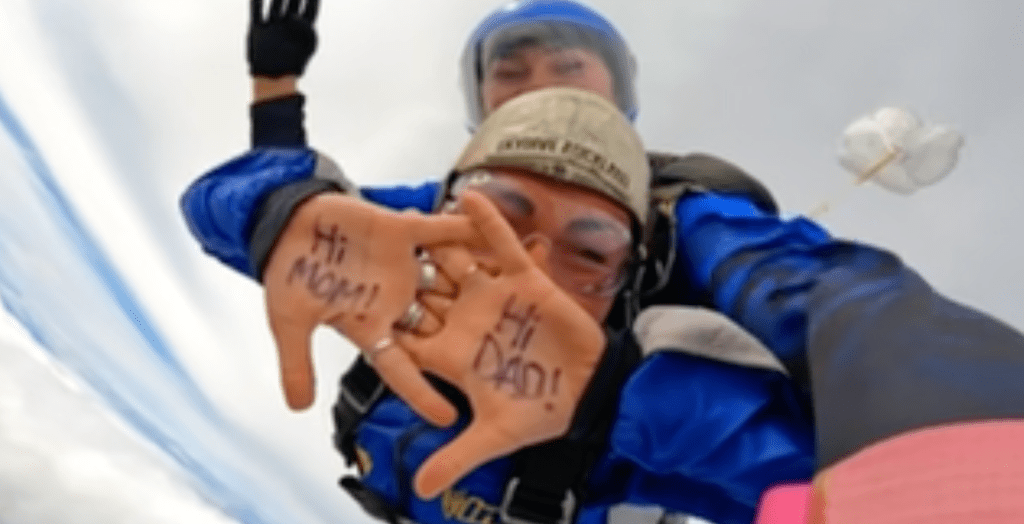
That’s it. No context. No “hey, by the way, I jumped out of a plane today.” Just the photo and the palms. Sarah and I stared at the screen for a while. It was only later that we got the full story. Sam and her boyfriend Brandon, while on spring break, had gone skydiving in New Zealand. Didn’t want to tell us in advance. Smart kid. I went back to sleep eventually, but it took a while.
Last Days in Gibraltar, April 5
The last few days before departure are always the same routine. Laundry. Water tanks topped off. Systems checked. And grocery shopping, which in Spain included an adventure at the butcher counter.
This time I wanted a whole chicken, spatchcocked. Backbone out, flattened, ready for the GN Cooker. Simple enough request in English. In Spanish, with a butcher who’s looking at you like you’ve just asked her to perform surgery on a pet, or maybe something more racey, it was a challenge. I mimed. (How do you mime a spatchcock chicken?) I gestured. I made increasingly desperate hand motions suggesting a chicken being opened like a book. Nothing. The stare got more intense.
Finally I pulled out Google Translate and typed it in. Mariposa. Butterfly. Her face lit up. “Ahh, mariposa!” And just like that, the chicken was butterflied and wrapped in paper and we were best friends. Years of Spanish classes, and I got bailed out by an app. How pathetic is that. I get bailed out a lot these days by tech.
Checking Out, April 6
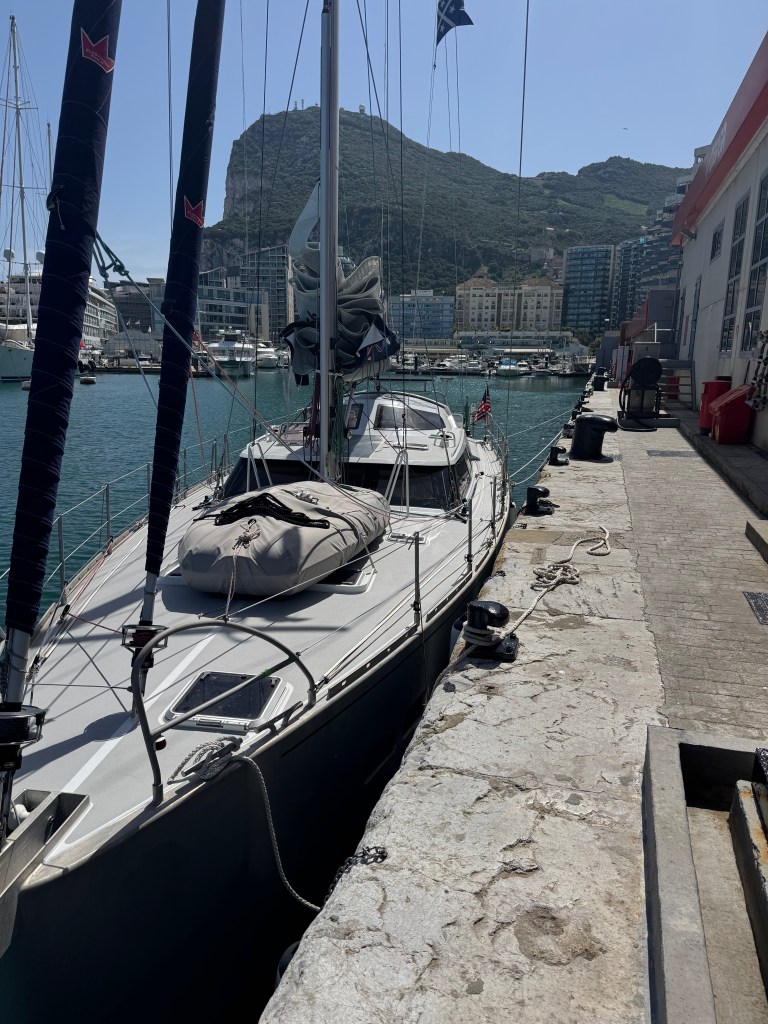
We walked over to immigration and checked out of Spain, then pulled off the dock at Alcaidesa Marina around 1210 UTC, 1410 local. Motored across the bay to the fuel dock in Gibraltar. Here’s the thing about Gibraltar. We’ve been staying at a marina in Spain this whole time, but Gibraltar is a separate customs territory. Not EU. So checking Spindrift in and out of Gibraltar is what should reset our Temporary Admission clock, the 18-month window that lets a non-EU flagged boat stay in European waters without paying VAT. That’s the whole reason we came here.
Filled the tanks. 272 liters of diesel for £369.38 sterling. For the Americans keeping score at home, that works out to about $6.53 per gallon. So no, it is not cheaper. Not even close. Back home you’d pay maybe four dollars and change for diesel. For comparison, our last fill-up was 936 liters at St. Helier on Jersey for £861, which comes to about £0.92 per liter. Gibraltar charged us £1.36 per liter. That’s nearly 50% more. But you’re not buying fuel in the shadow of a 1,400-foot limestone rock with monkeys on it, so there’s that.
While at the fuel dock we completed the check-out from EU customs territory. Paperwork done, receipts saved, photos taken for the file. Then we motored back out and dropped anchor in Gibraltar harbour for the night.
Into the Med, April 7
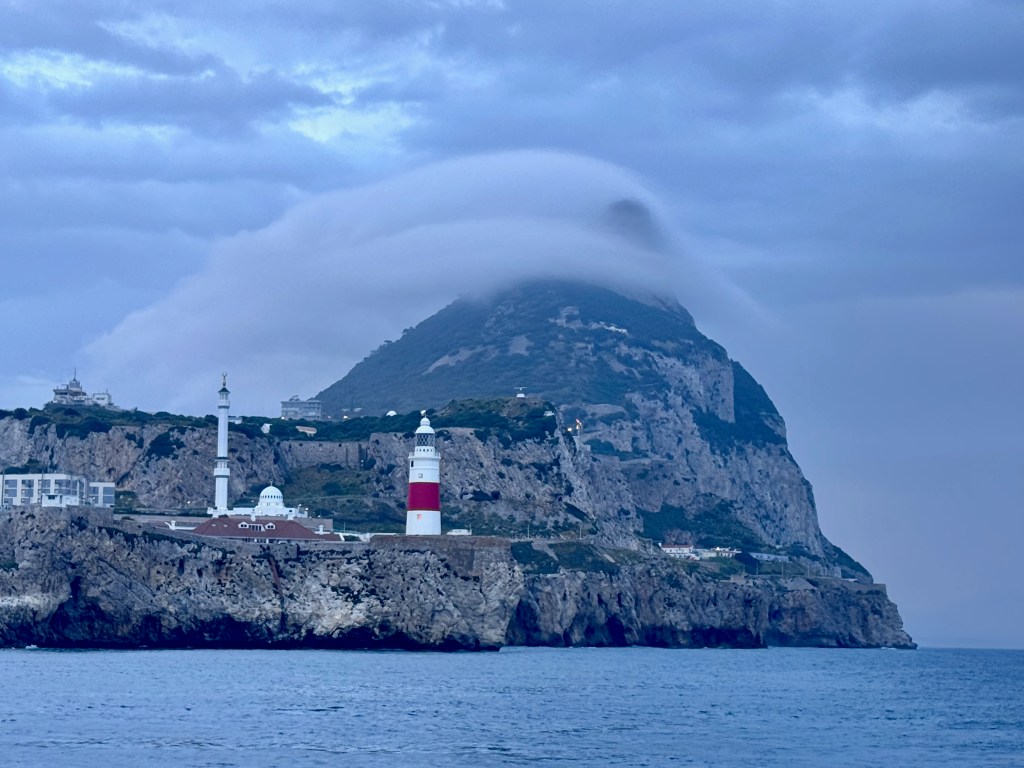
Pulled anchor at 0532 UTC, 0832 local. Still dark. The harbour was full of ships, a dozen or so cargo vessels and tankers, 300 feet or better, sitting at anchor like sleeping giants. We threaded through them quietly, running lights on, radar up, coffee in hand. It made me think about people I know who’ve done this in a different way. Tommy “Quattro” Green. Carrter and Carrson Pearce. How many times did they motor in and out of this same harbour, past these same ships, in this same dark, on their way somewhere? The merchant mariner runs through this strait like blood through a vein. It is brutally clear at 5 AM.
The moon was waning. It was raining. The VHF was busy. Gibraltar traffic, Tarifa traffic, cargo ships announcing their intentions and asking for course corrections. Mostly in poorly spoken English. We rounded Europa Point Light as the sky brightened. Beautiful morning, rain and all. (Photo above.)
We picked up a nice breeze and settled into a broad reach for the first part of the morning. Spindrift was moving well, heeled over, the kind of sailing that makes you forget you were up before dawn. Then it all fell apart.
Here’s the lesson: when the weather models disagree, don’t pick the one you like. Pick the cautious one. I know this, but sometimes human nature gets the best of me. We had two models showing different things, and we went with the optimistic forecast. Bad call. The wind just died. Dropped out like someone flipped a switch, and suddenly we were motoring into a grey, flat Mediterranean with no breeze and no options.
This stretch of the Spanish coast between Gibraltar and Malaga is not generous to cruising sailboats. There aren’t many places to anchor, and the harbours are few and not always welcoming. We pushed on toward Malaga, figuring we’d make it by late afternoon. Another bad call.
Around 1500 local we radioed Malaga Port Control and asked about entering the harbour. First question: do you have a port agent? A port agent is a local representative who handles a vessel’s paperwork, customs, and logistics. Essentially your liaison with the port authority. Commercial ships always have one. Recreational sailboats almost never do. We said no. And with that, we were politely told to move on. Malaga turned out to be exclusively a commercial port, and without an agent, we couldn’t anchor or tie up. Some cheat the system by turning off their AIS, entering right as the sun sets, and by the time they find you the next morning you are on your way. But we didn’t feel that bold. Lesson learned.
So there we were. Tired, running out of daylight, scanning the chart for anywhere we could tuck in. And then luck turned. We found Caleta de Vélez, a small harbour down the coast. Not well protected. A lee shore, but the winds were less than 5 and projected to disappear completely. We dropped anchor at 1755 UTC, 1955 local, and spent the night rolling in the swell, the anchor chain grinding, sleep coming in intervals between checks and AIS anchor watch alarms as the boat swung around on its anchor.
Oh, and the fish farms. Nobody tells you about the fish farms. They’re everywhere along this coast, many of them poorly marked or not marked at all. Motoring through fading light, tired, scanning for an anchorage, and playing hide and seek with massive nets and floating pens that don’t show up on the chart. Some days you just want to be home on the couch binge-watching some trash. This was one of those days.
But we got through it. Mother Nature sent the bill, and we paid it. 96 nautical miles for the day. And in hindsight, we’d probably make the same call. We needed to move northeast.
Fighting Back, April 8
Up early. Coffee. Check the systems. Up with the anchor at 0601 UTC, 0801 local. But this time we knew that Mother Nature was back at the register, ready to charge us again.
This time we were ready to fight back. The wind filled in from the west, setting us up for a very deep reach in the low 30s, gusting close to 40 knots. One reef in the main, J1 as things built then the J2 up front as things got sporty. Lee dagger board down. Centerboard up. This is the sailing that Spindrift was built for. She’s heavy, stiff, and she eats this stuff up. The boat was less tired than we were.
It was a fresh breeze and despite a long fetch the seas never really had a chance to build past a meter, maybe two. The kind of sailing where going forward we clipped into the jacklines because of the rolling. Spindrift was surfing down the modest waves. 11 knots at times, averaging 9 over the ground. We secured everything and let her run.
We made Puerto Adra by 1445 UTC, 1645 local. 67 nautical miles. Tied to a dock. An actual dock, with cleats and fenders and no rolling. After a hot shower and a great dinner, we were in bed by 8 PM. No complaints.
Adra, April 9
The models are confirmed. We’ll be here for a couple of days. The wind is wrong and strong, and nobody’s going anywhere. We are learning that this is the rhythm of coastal passage-making in the western Med in spring: sit tight for one to three days during a blow or when the wind is from the wrong direction, then move in a weather window. Repeat. You make the best of the waiting. Adra is a working fishing port, not a tourist marina. There’s good coffee ashore and the people are friendly. We’ll be fine.
The Saharan dust is still falling. Spindrift looks like she rolled through a construction site.
What’s Next
We’re watching the forecasts for our next window to push east. The next few legs will take us along the Spanish coast toward the Balearic Islands, and the timing depends entirely on the weather.
Speaking of weather, our next post will be about the Tramontana, the fierce northerly wind that funnels down through the Pyrenees and across the western Mediterranean. If the Levante is the gatekeeper of the Strait, the Tramontana is the bouncer of the Balearic Sea. Cold, dry, and strong enough to keep you in port for days. We’ll get into the details of what it is, how to read it, and how it shapes our passage plans between here and Mallorca.
Until then, we’re sitting tight. The wind says stay, so we stay.
Fair winds from S/V Spindrift


 S/V Spindrift
Leave a reply to Anthony Mercurio Cancel reply