
We left off sitting tight in Puerto Adra, coated in Saharan dust and watching the forecasts. That was April 9th. What we didn’t know yet was that the weather had one more card to play before it would let us go.
Meeting a DANA, April 10
Before we left on this trip, I’d read about DANAs but never met one. DANA, Depresión Aislada en Niveles Altos, is what they call it when a pool of cold air breaks off from the jet stream and just sits there, high up over the western Med, waiting. When that cold air meets the warm, wet air rising off the sea below it, things go sideways fast. The locals talk about them the way you talk about a neighbor’s dog that’s bitten someone. Respect it. Don’t turn your back on it.
We’d been watching the forecasts all day. The forecasting tools we use (PredictWind, ECMWF, GFS) are good, but they show you surface conditions. Wind, pressure, waves. A DANA lives higher up, around the 500 hPa level, where a pool of cold air breaks away from the jet stream and parks itself over the Med. To actually see one forming, you need to look at the upper-air geopotential height charts. I have not been doing this. If Gamma knew, she would have slapped me in the back of the head. “Sonny, you dumb ass. The 500 hPa charts. Look at them.” Yes, Gamma. I’m looking. I promise. But here’s the bummer. Even when the models flag the ingredients, they can’t tell you exactly when the cake comes out of the oven. You just know it’s possible, and you prepare and wait.
DANA arrived around 1900 local on April 10th. Like something alive came knocking on the hull. We recorded sixty-two knots.
For the non-sailors, that’s hurricane force. Wind that turns loose objects into projectiles and standing water into spray. The boat next to us was rolling against her fenders so hard I thought they would pop.
We were tied up. If we’d been at anchor, or worse, at sea, it would have been a very different story. I’m sure we could have weathered it. And then it passed. Maybe five minutes, start to finish. In its wake, a layer of dust and dirt settled over everything. So, have you ever met a DANA? I hope you haven’t.
I had just finished washing the boat that morning. Just finished. Spindrift was now brown from bow to stern. I washed too many boats as a kid to volunteer for this one. Today I was going to be that owner. The one who looks at a brown boat and says…..nah.
Mice Coming Out to Play, April 11
We left Adra at 0529 UTC, 0729 local, as the sun rose. Bow pointing northeast. A little rain. Light air. And as we motored past the small harbors dotting the coast, sailboats started appearing. One boat. Then two. Then a handful more. All emerging from their hiding spots like mice creeping out while the cat slept. It was reassuring. If other boats were moving, it meant we’d all read the weather the same way. The weather window was open.
We picked up a nice downwind sail for part of the morning, though the breeze was inconsistent. Lots of holes. Patches where the wind just disappeared and we’d have to fire up the engine and motor through until the next puff filled in. You take what the wind gives you and motor through the rest.
The Boy, the Buoy, and the Man Named Mark, April 11
Around 1245 UTC, 1445 local, about seven miles northeast of Faro de Mesa Roldán, things got interesting.
About an hour earlier, S/V Zarafa, an Australian boat sailing behind us (MMSI 503132130), had called. “Sailing Vessel Spindrift Sailing Vessel Spindrift this is Zarafa, Channel 16”. They wanted to know if we’d picked up an AIS-SART signal. An AIS-SART is an emergency beacon. A Search and Rescue Transmitter that broadcasts a distress position over the AIS network. When one of those alarms goes off, you come to attention.
Zarafa hadn’t gotten a clean copy of the transmission. Neither had we. Partial signal, unclear position. We both logged it and kept moving.
Then a Port Control station called Spindrift on Channel 16. In heavily accented, broken English, they told us there was “a buoy in the water” near our current AIS position, and they needed our assistance. Asked us to switch to Channel 72.
“A boy?” I said. Then “Sarah. Someone needs our help.”
“Yes. A buoy,” they replied.
“What exactly am I looking for? A head bobbing in the water? Is he on a paddleboard?”
“A buoy. He is wearing green.” Is what I thought I heard.
Sarah and I sprang into action. Life ring at the ready, binoculars out, both of us scanning the horizon from the cockpit. Nothing. Open water in every direction. No debris, no person, no green anything.
Zarafa was now about two nautical miles behind us and jumped in on the radio. “Are we talking about a boy?” the skipper asked. The answer was yes. A buoy. Zarafa’s skipper, a good old Australian, paused for a moment and then sorted the whole thing out.
“A mark?” he asked. “Are you looking for a mark?”
“Yes. A mark.”
And just like that, it was over. We both now assumed that Port Control had been asking us to locate a navigation buoy, a green buoy, that had broken free from its mooring. Not a person. A buoy. Not a boy.
I felt like a fool.
But I had to ask. I got back on the VHF. “Sailing Vessel Zarafa, Sailing Vessel Spindrift. One more question, Captain. Could the boy’s name have been Mark?” We had a good laugh about that one. The kind of laugh you get when you’ve been scared for a few minutes and then it turns out to be nothing. About a mile later, we spotted a green navigation mark floating loose on the water. We reported its position to Port Control. Mystery solved.
Garrucha, April 11 Evening
We pulled into Garrucha at 1659 UTC, 1859 local. Eleven and a half hours, 69 nautical miles. A beautiful, relatively new marina sitting right in the center of town. Live music coming from a bar on the paseo. A band playing Bon Jovi covers. Perfect.
We found a table, ordered a bottle of wine, and people-watched. It was a wonderful ending to a strange day.
When we got back to the boat, who was tied up right next to us? Zarafa. I walked over and knocked on the hull. Perry, the skipper, the voice on the other end of that radio exchange, climbed out of the companionway with a grin. We invited him aboard for wine and a snack.
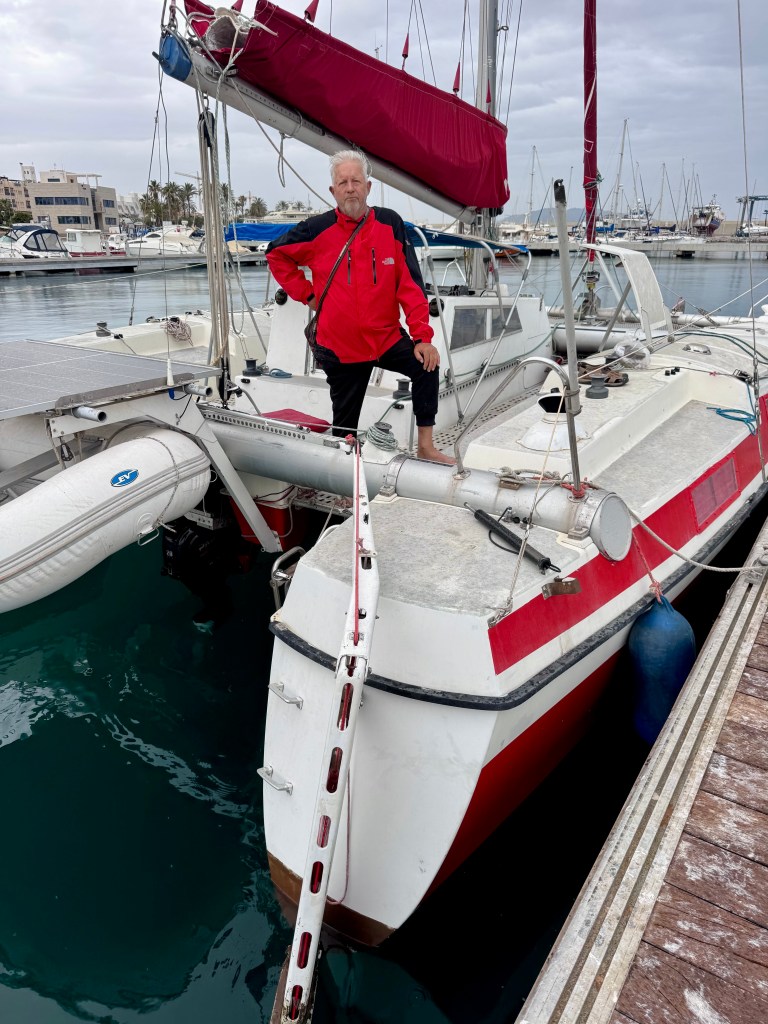
Perry is sailing solo. 75 years old. Brave in these waters. He bought his boat in the Azores and is now cruising the Med on his own. He told us he was a surf bum from Sydney, spent years teaching at the University of New South Wales, and picked up sailing late in life. The only other boats on our dock were crewed by solo sailors too, almost always French. There’s a quiet fraternity out here among people traveling alone by sea. Fascinating people.
We’ll likely see Perry again. He’s headed the same direction. Balearics, then Corsica, Sardinia, and beyond. We appear to be on the same path, though we have a small detour planned: Cannes in September, where Spindrift will be on display once again at a boat show, hosted by Boréal.
The Red Prawns of Garrucha, April 12–13
Garrucha is the kind of place you’d never find on a cruise ship itinerary, and that’s exactly what makes it worth visiting. This is authentic Spain. A laid-back fishing town on the coast of Almería where the paseo marítimo fills up at dusk with families and kids running between the café tables and two-stroke motorbikes screaming through town. Old men tending to their nets. No souvenir shops selling junk. No tourist menus in four languages. This is why we travel by boat. To stumble into places the cruise ships and international tourists will never go.
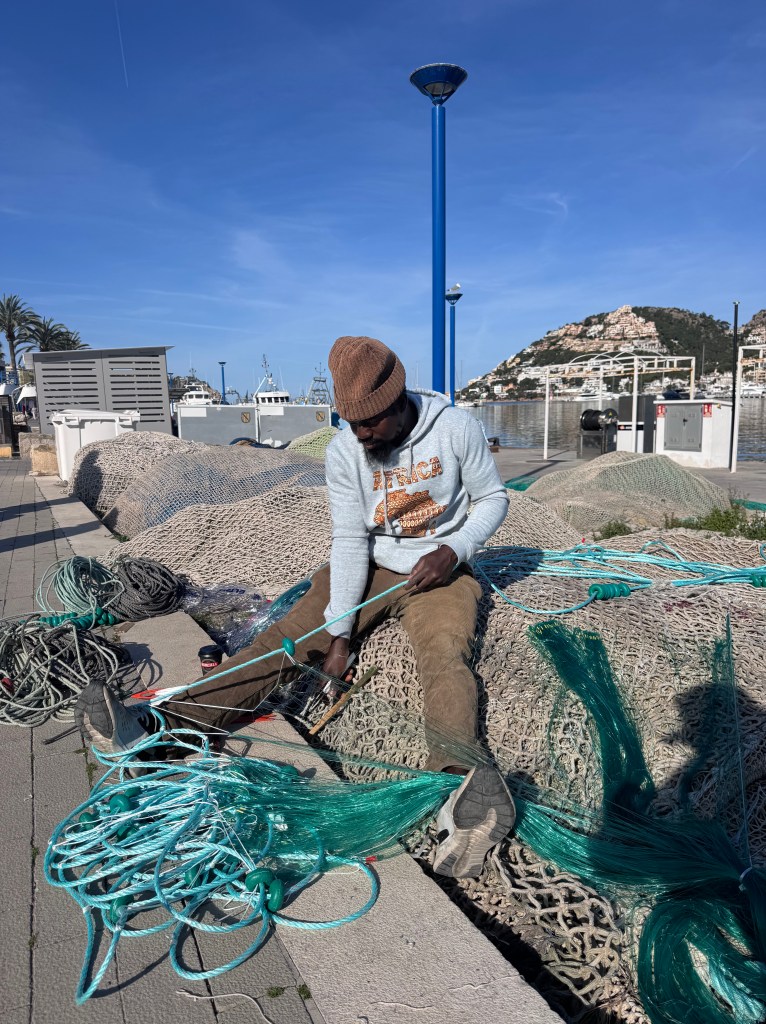
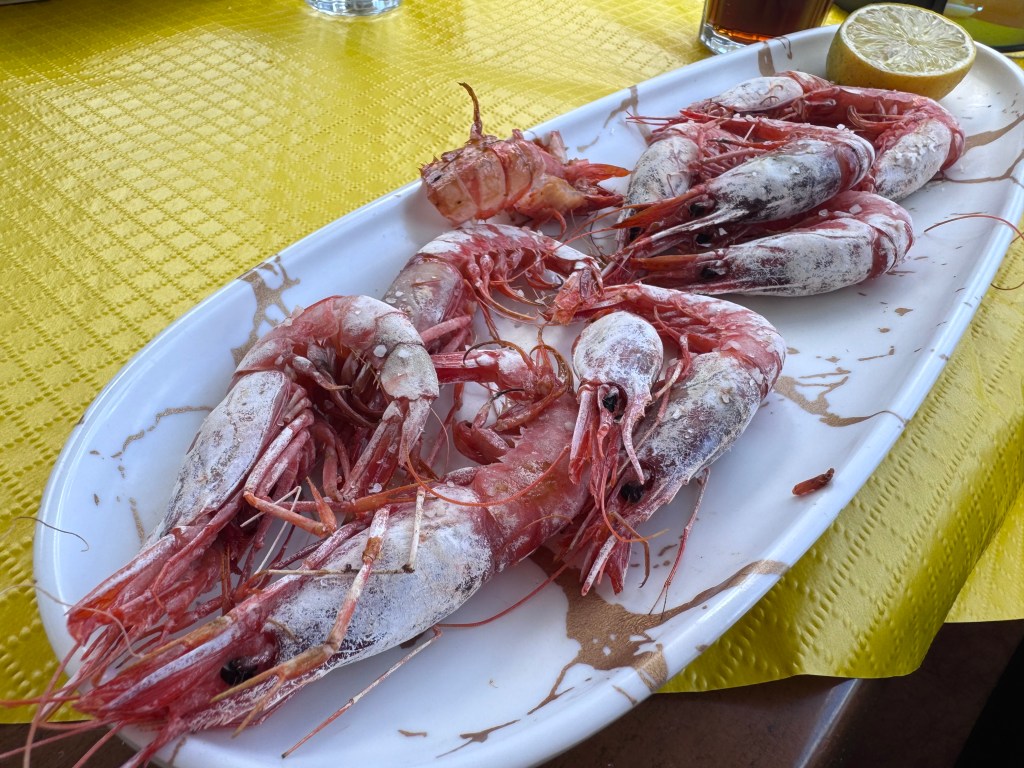
We slept in on the 12th. Lunch on the waterfront followed by a long walk around town. Garrucha is famous for its gamba roja, red prawns pulled from the deep waters offshore. They serve them simply. Grilled with coarse salt. The flavor is something else.
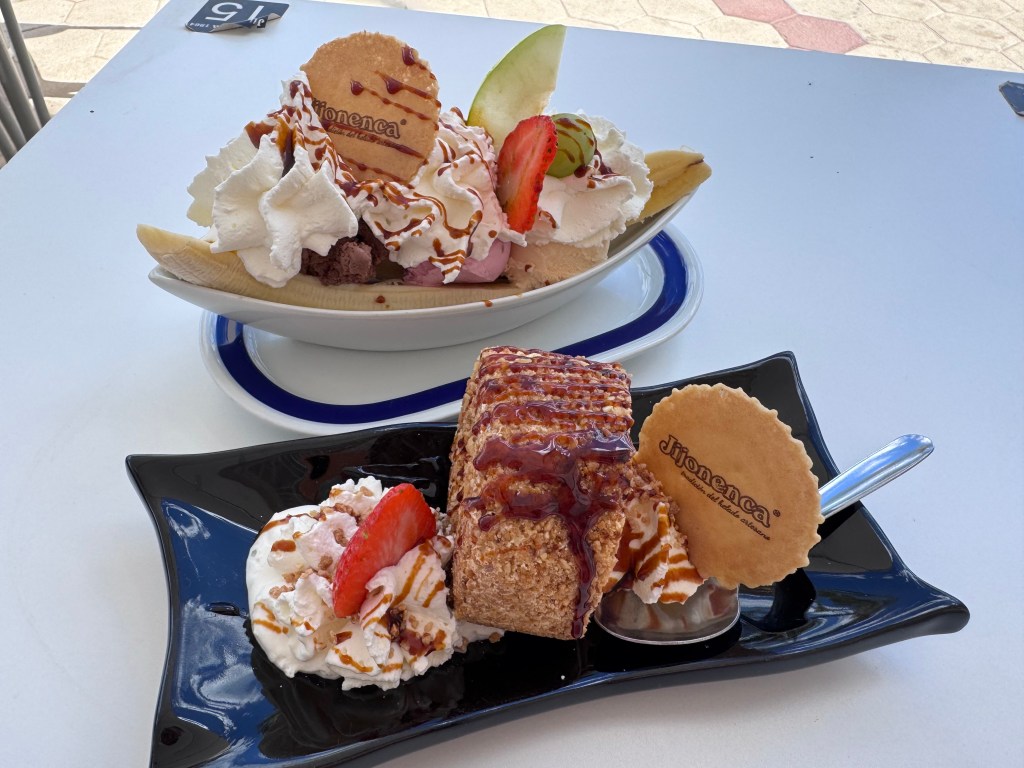
The next day was provisioning. A one-mile walk to the Lidl with the big Patagonia rolling duffel, our version of a grocery cart. We stocked up on everything we’d need for the crossing to the Balearics. That evening we had ice cream on the paseo for dinner. Yes, ice cream…..sometimes you just need to break some rules. (see picture) Topped off the water tanks, and studied the forecasts one more time. The weather window was opening on the 14th. Departure at 0800. Target: Ibiza.
The Crossing, April 14–15
We slipped lines at 0602 UTC 0802 Local and pointed Spindrift east along the coast. The sailing was immediate and beautiful. The coastline here is mountainous. Dramatic mountains that seem to be dropping straight into the sea. You feel small in the best possible way.
The sunset that evening was not that spectacular. Wind died and we were forced to motor. Then came the stars. On a passage like this, once the sky goes fully dark, you’re reminded of what the sky actually looks like without light pollution. Sarah heated up something from Lidl. A tortilla española, one of those thick Spanish potato quiches loaded with onions and potatoes. And then Sarah, casually, like it’s nothing, pulls a fresh loaf of sourdough out of the oven. We’re twenty miles from shore. In the dark. On a passage. And Sarah is baking bread. French butter with salt. We are loving life.
After dinner we settled into our watch schedule. The night was dark. Truly dark. Sarah took the first watch. And since we were in a major shipping channel she got the first shot at playing Chutes and Ladders with the tankers and freighters. It seems like they are just all over the place this night. Coming at you from all directions, aft and forward, 10, 15 or 20 knots….all while we are at a steady 7. They all show up on the radar, you just are calling out occasionally to make sure we don’t need to alter course.
At about 2234 UTC on April 14th, 0034 local on the 15th, Spindrift crossed the Prime Meridian. Zero degrees longitude. I know it’s an imaginary line. But when you watch the digits on the chartplotter tick from W to E, quietly, in the middle of the night, it feels like something. Every mile we’d sailed so far had been in the western half of the globe. Now we were in the eastern half.
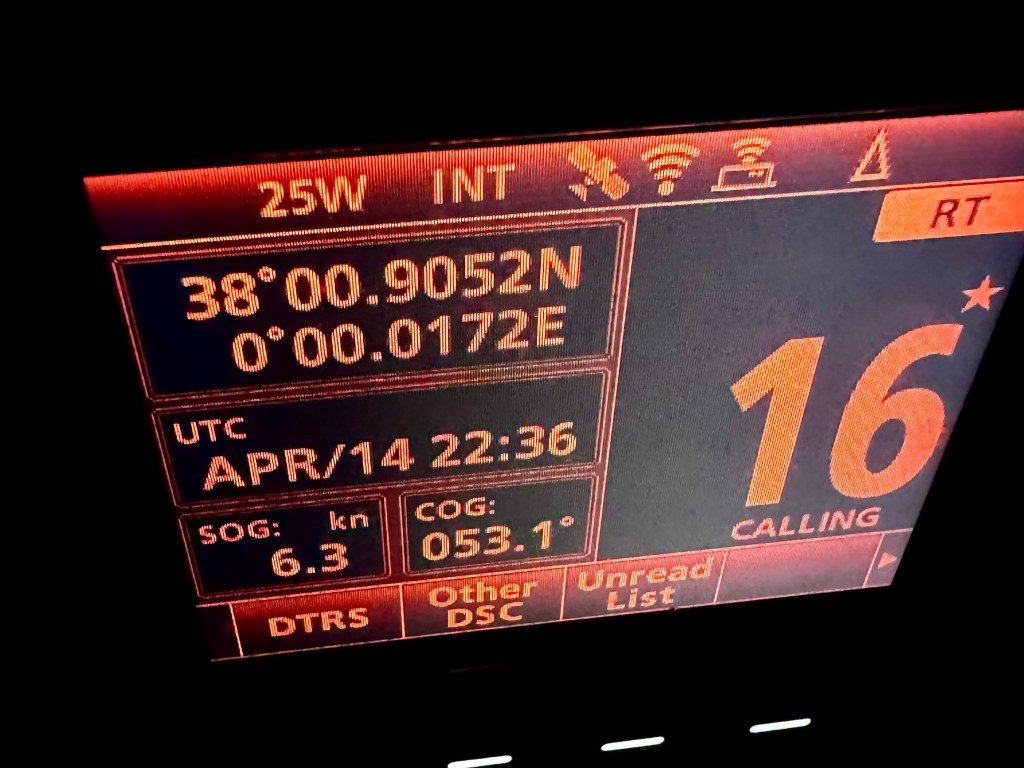
The moon, a waning crescent at about eight percent, didn’t come up until around 0407 UTC. A thin sliver in the eastern sky just before dawn. The wind had died overnight, as the forecasts predicted. We motored through the small hours. Then the sunrise on April 15th and there was Ibiza, slowly coming out of the haze on the horizon.
We pulled into San Antonio, Ibiza, at 1236 UTC, 1436 local. 195 nautical miles from Garrucha. About 30 hours on the move.
Ibiza, April 15–16
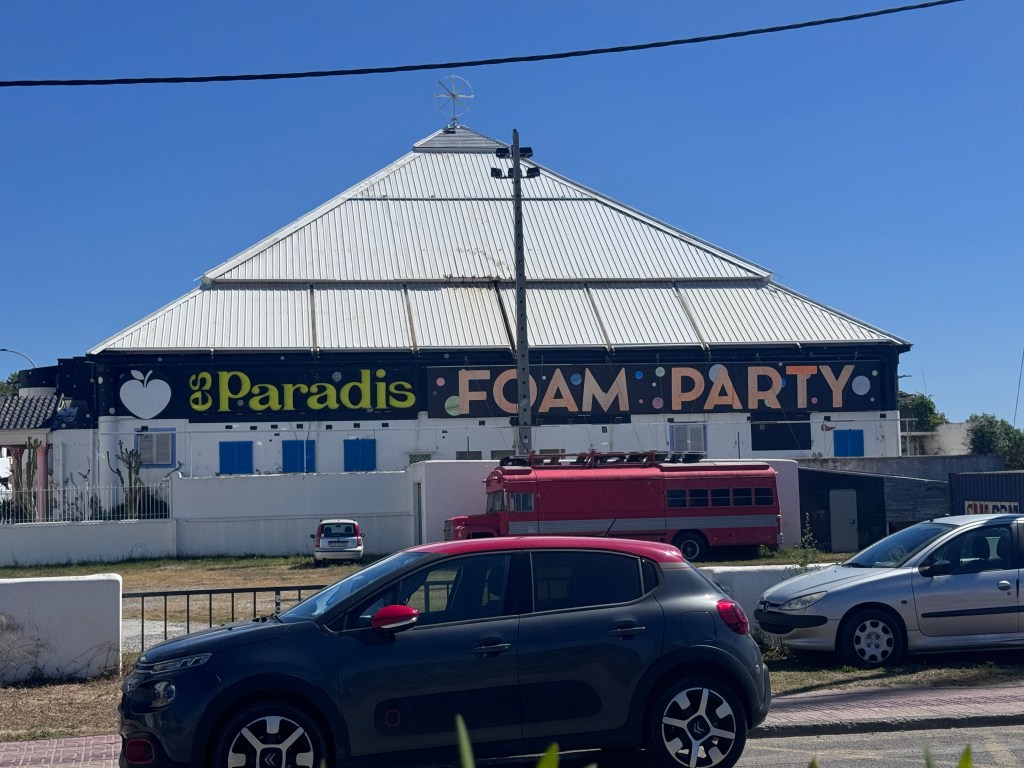
We’re in San Antonio, Ibiza. The Ibiza of nightclubs and DJ sets and foam parties. That one. Not the one where fishermen mend nets in the morning and the old town smells like salt and stone. We spent a couple of days here catching our breath before the next hop east. And no, we didn’t hit the foam party……but we wanted to.
San Antonio to Andratx, April 17
No wind. That’s the whole story of this passage, really. We slipped lines from San Antonio and pointed Spindrift east toward Mallorca under bright sun and flat calm seas. Not a ripple. Not a puff. Flat enough to spot the basking sunfish. Lots of sunfish. Motor and motor and motor. Sixty-three nautical miles of diesel-powered not sure what to call it.
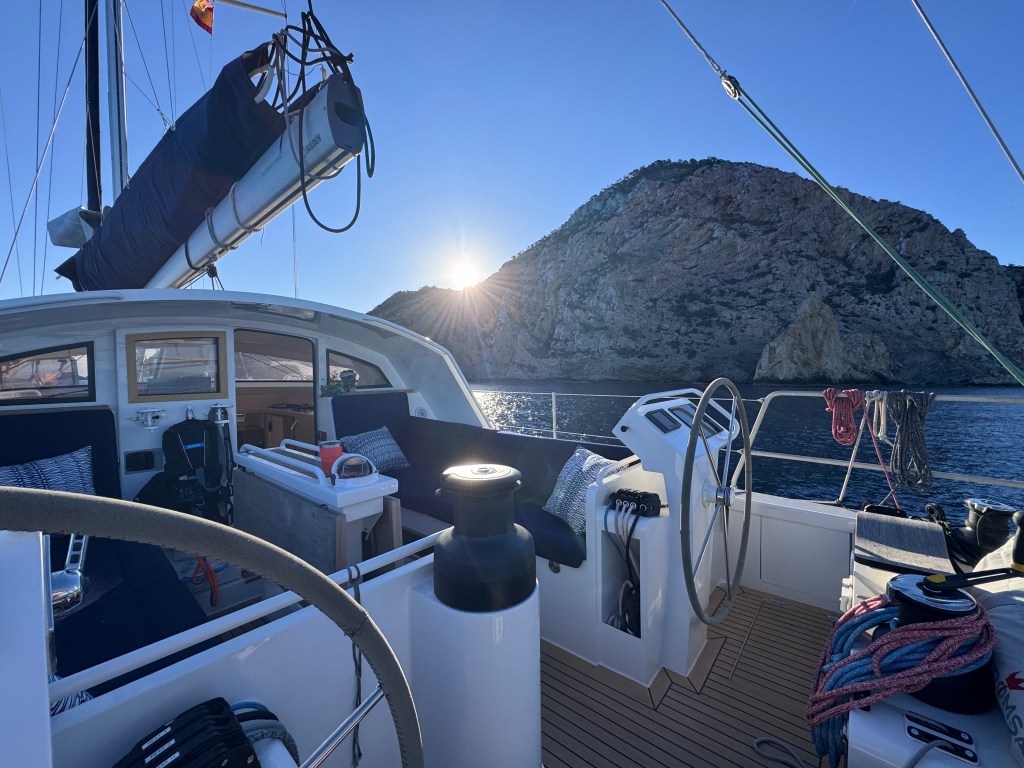
We pulled into Andratx at 1536 UTC, 1736 local. Sixty-three nautical miles. Port d’Andratx is tucked into a deep inlet on the southwestern corner of Mallorca, surrounded by steep, pine-covered hills. You round the breakwater and immediately feel protected. As we come in and wait for our slip to open, we become a turning mark for two dozen or so Optimist Prams and Lasers. Coaches in chase boats yelling out, in Spanish, what I’m sure translates to “pull in that mainsheet” and “keep that boat flat.” After a full day of open, glassy sea, it was good to be in.
What’s Next
We’re in Mallorca. We survived a DANA, a lost boy who turned out to be a buoy, and nine hours of motoring. Andratx is our first stop on the island, and from here we’ll work our way around the Balearics for a month or so. We have a special guests arriving on the 19th.
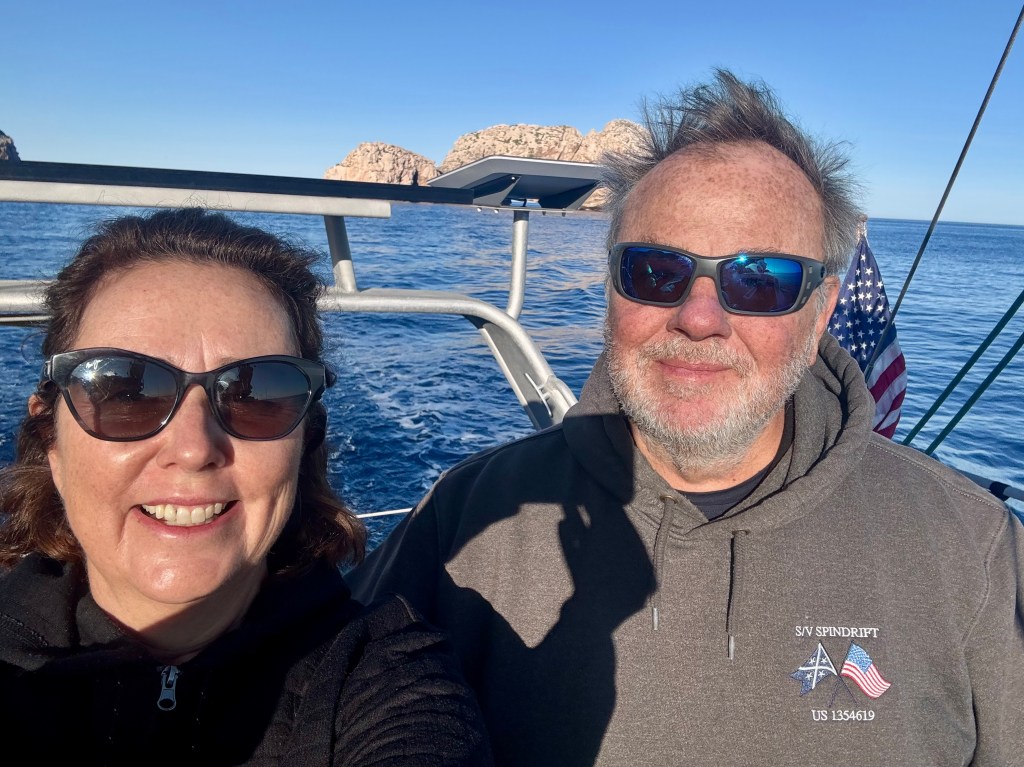
Fair winds from S/V Spindrift


Leave a Reply