
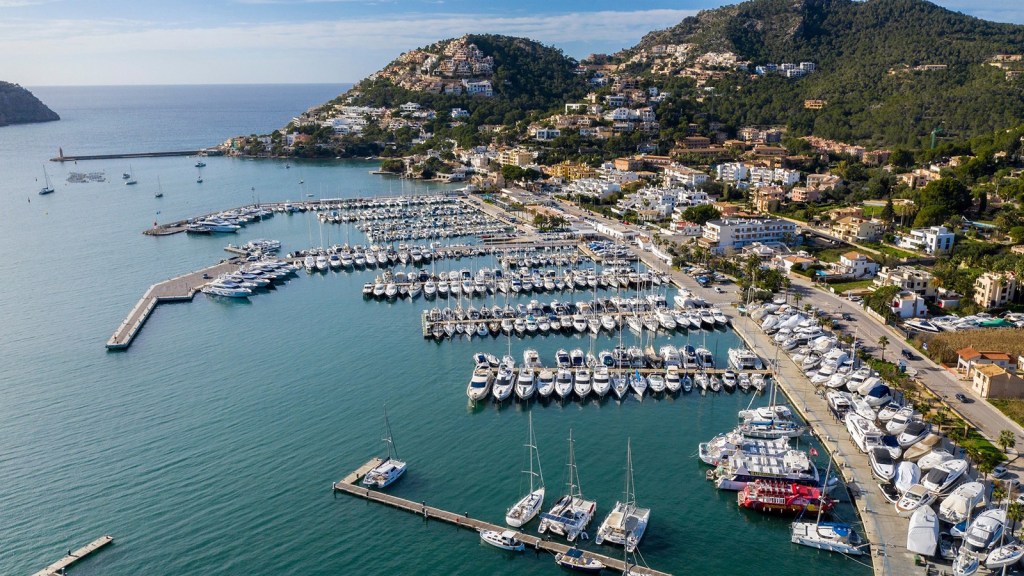
We left off in Port d’Andratx, freshly arrived from Ibiza after a full day of glassy, motor-only sea. The plan from here was simple. Stay put. Catch our breath. Get ready for company. In a few days, four friends would step off a plane and onto the dock, and for the next twelve days we would laugh, explore, and tell old stories.
This post is a little different from the others. Less about wind and routing, more about what it is actually like to live aboard with six adults for the better part of two weeks, and the absolute fun we have with friends aboard. Spoiler: you stop showering, you start counting amp-hours, and you swim a lot.
Prepping for Company, April 17–19
A couple of days in Andratx is a gift. We were plugged in at Club de Vela Marina, a great facility, not far from Palma or the airport. The club was active with Optis and Lasers. Andratx itself is a tucked-in bowl of pine-covered hills with a working marina at the bottom, and you can do the unglamorous boat-prep work like provisioning, laundry, and scrubbing, as well as catch up on emails, pay bills, and arrange the next set of travels for Hannah and Samantha, while still feeling like you’re on vacation.
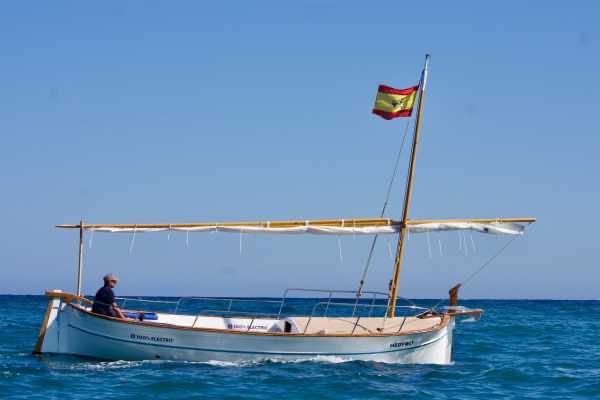
You know I love old boats, and there is no shortage in Andratx. Tied up around us were the traditional wooden boats of the island. The Mallorcan llaüt is distinctive and functional, known for its robust hull and raised bow, built to handle the turbulent waters of the Mediterranean. Check it out.
The Crew Arrives, April 19
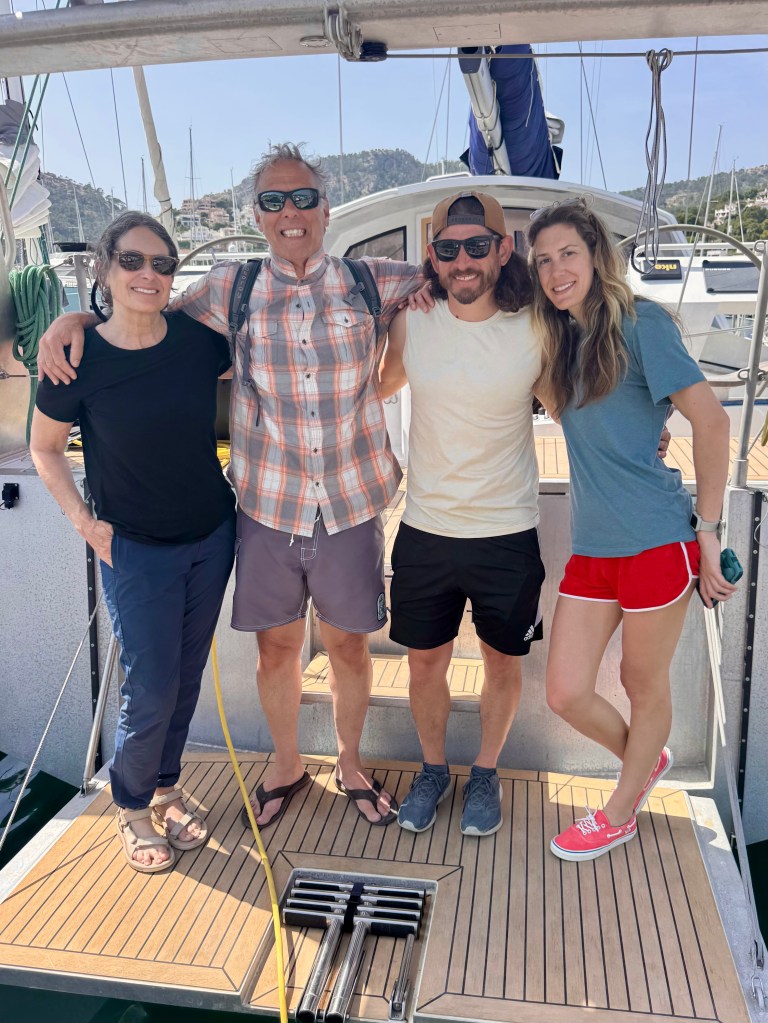
Right on time. Rick, Lisa, Chris, and Julia rolled up to the dock with luggage and grins. We have been keeping in touch all these years, and now here they were, ready to spend twelve days aboard Spindrift. Rick is a high school and college buddy. Julia is his daughter. Chris and Lisa are their partners. Really nice to catch up…..really!
Six Aboard
Spindrift is comfortable for two, perfect for four or six, with a little choreography when you hit six. The first night sets the tone. Safety check. Where do bags go? Where do you plug in a USB-A, a USB-C, or anything else? By breakfast on day two you have answers, and the boat feels less crowded than you thought it would.
But six on a boat is mostly a story about the conservation of food, water, and power.
The fresh water tanks hold 1,500 liters, and with six people aboard the math gets tight in a hurry if anyone treats the boat like a hotel. So we don’t. Long, hot, soapy showers come off the menu the moment the crew steps aboard. When the day is warm and the bay is clear, you put on a swimsuit, take a flying jump off the swim platform, and call that your shower. A bar of biodegradable soap on the stern, a quick rinse with a few cups of fresh water from a hand sprayer, and you are clean enough. A Mediterranean Sea bath at five in the afternoon, with a glass of something cold waiting in the cockpit, is no hardship. If push comes to shove, we can make water on Spindrift with our Blue Water Desalinator. But it requires us to be in relatively clean water (not a harbor where boats may be dumping their black water tanks) and to run the Panda generator. It is a task you try to avoid.
In a marina, plugged into shore water, the showers don’t disappear. They just become “navy showers.” Two minutes, tops. Wet down, kill the tap, lather, turn it back on for a quick rinse. The first time a guest tries it, it is hard. By their second shower it is automatic. Or you go ashore and use the locker room shower most marinas have. If you are lucky, the shower does not auto-shut-off and you finally get that hotel-style long, hot shower. A real treat.
We can also run our Soba BabyNova clothes washing machine, which we typically reserve for when we are connected to shore power for obvious reasons. The BabyNova is small. Max load of 6 pounds of dry laundry. For reference, a typical US home machine handles 25 pounds plus. A washer but no dryer. You reserve washing for the days you know you can hang clothes to dry on the lifelines. Which gives us that vagabond look.
Then there is the head, the marine toilet. After a few seasons aboard you become an unwilling expert in marine plumbing. You learn the single most important rule on a boat, the one we recite at every guest orientation: nothing goes into the head except what came out of your body. Nothing. No paper, no wipes, no Q-tips, no hopes. The plumbing is narrow, the pumps are temperamental, and the consequences of a clog at sea are best left out of a family blog. A year aboard Spindrift, and you will never take a house toilet for granted again.
Electricity has its own discipline. At anchor, our solar panels and house bank carry the load, but Starlink (which runs on 120V), six phones, plus the three fridge drawers, one freezer drawer, the lights, and the minimal instruments. It adds up fast. So you find a rhythm. We can always run the generator, but we try to avoid the noise. So we conserve.
Then there is the galley. Six mouths, limited storage, dinners get inventive. By day three or four we are not so much cooking as pulling things together. A handful of pasta. The last of the chorizo. A tin of tomatoes. Sardines, canned tuna, and dried butter beans. Half a lemon someone forgot in the fridge door. Sarah is the master of this game. She can stand in front of an open fridge for ninety seconds, close it, and announce dinner. The crew chops, stirs, pours. The cabin smells like garlic and olive oil. Plates come out, and the meals scraped together from the bottom of the fridge are the ones we still talk about a week later.
Storage is a religion. Every locker is mapped. Every item earns its place by having at least two uses. The cutting board is a serving tray. A sail bag is an extra cushion. Empty cabinets are not failures of provisioning, they are victories. When you find one, you celebrate by putting nothing in it.
Underneath all of it is the negotiation that runs every cruising day: where you want to be versus where you can safely be. Every move is a balance. Seeing what you came to see, and making sure you can get there, anchor properly, and sleep through the night. Sometimes the chart and the forecast vote yes. Sometimes they vote no. The crew occasionally wonders why we changed the plan. The wind, almost always, is the answer.
That is the texture of life aboard with six. Less hot showers, more swims. Less electricity. Less menu, more improvisation. Less stuff, more space. Nobody complains. That is the giveaway. Once you let go of the idea that the boat owes you anything, you notice how much it gives you anyway.
A Day in Palma, April 20
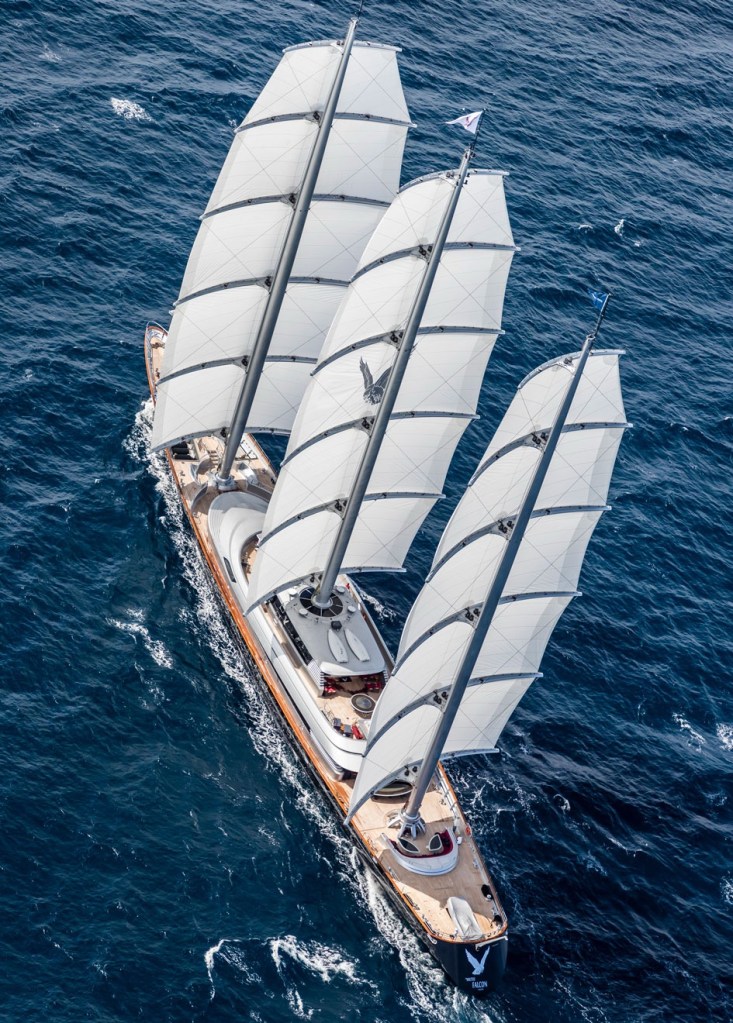
We left the boat behind for a day and drove into Palma. Chris took the wheel and got us in, around, and back out without a single wrong turn. Palma rewards a slow walk. The cathedral, the old town, the harbor full of the kind of yachts whose owners might look at S/V Spindrift and say, “you got a cute little boat there.” For scale: we walked past S/V Maltese Falcon, the famous 88-meter, three-masted DynaRig schooner launched in 2006.
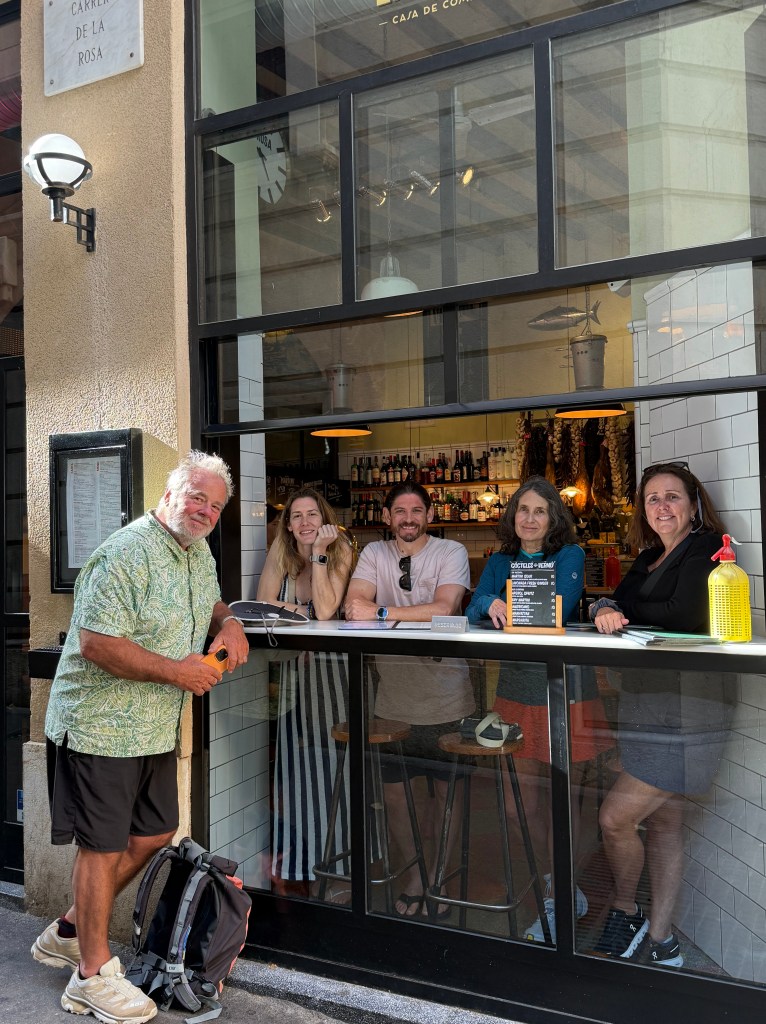
We ate. We wandered. We talked. We got to know each other again the way you only can when you are not on a schedule. Rick and I led the storytelling. Bicycling across the country in about thirty days with no money. The crazy college jobs, packing fish in Galilee, RI at Global Seafood. The getting into trouble. Probably boring for Sarah, Lisa, Julia, and Chris, but they were good sports about it. Rick still swears he never got into trouble. All those stories are clearly fake news.
Andratx to Sóller, April 21
We slipped lines from Andratx at 0810 UTC, 1010 local. A late start for us, which felt about right for a crew on vacation. The plan was a short hop up the west coast of Mallorca to Sóller.
The wind did not get the memo. We motored out of the entrance expecting the forecast northeasterly to fill in. Instead, we got nothing. Truly nothing. At one point I looked at the chartplotter and the true wind speed read 0.0 knots. Not 0.3, not 0.7. Zero point zero. In years of sailing I can count on one hand the number of times I have seen that screen sit on a flat zero. Usually it twitches, a tenth, three-tenths, even on a still day. Not this morning. The sea was a sheet of glass. You could see the cliffs reflected upside down on the water, Spindrift moving through her own twin. The old Med saying, usually too much wind or not enough, is proving to be true.
So we motored. Up the west coast of Mallorca, inside Dragonera Island, also known as Sa Dragonera. We hugged the shore there, watching small fishing boats drop their nets in the shadow of enormous cliffs. The fish, apparently, like the shade. The cliffs throw a cool, dark band on the water in the morning, and that is where the boats were working. It was one of those quiet mornings on the water that make you forget you came here to sail.
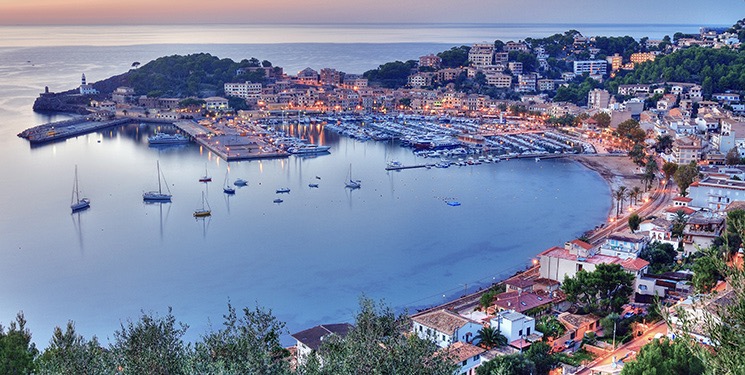
We dropped the hook in Sóller at 1253 UTC, 1453 local.
Sóller, April 21–22
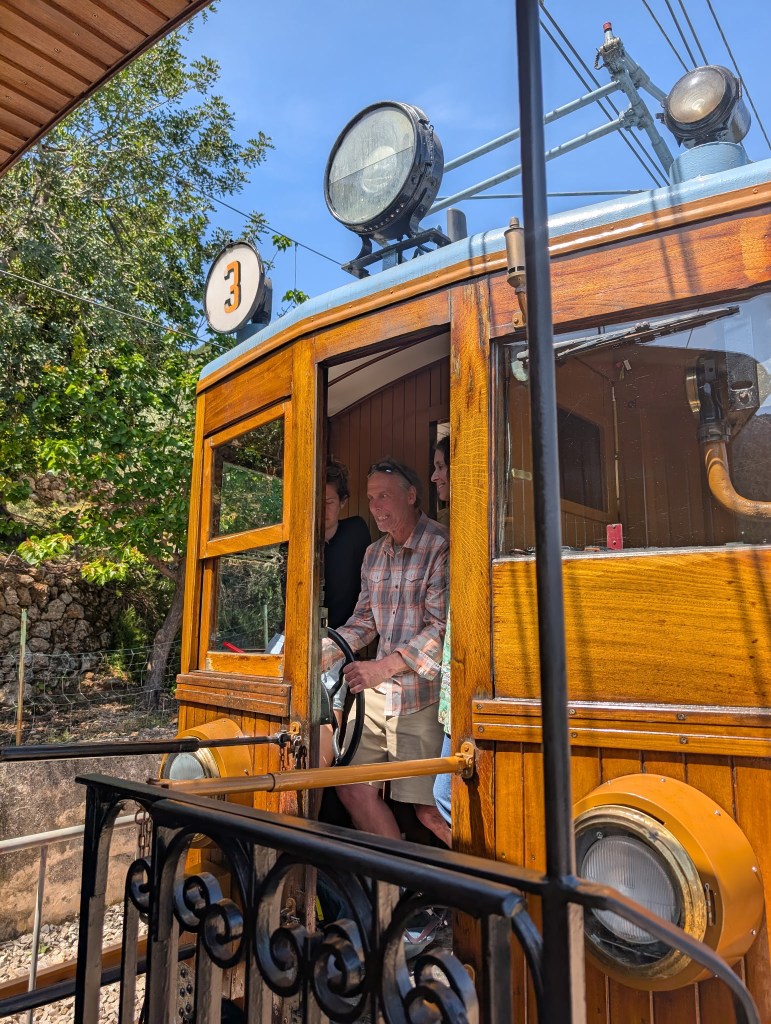
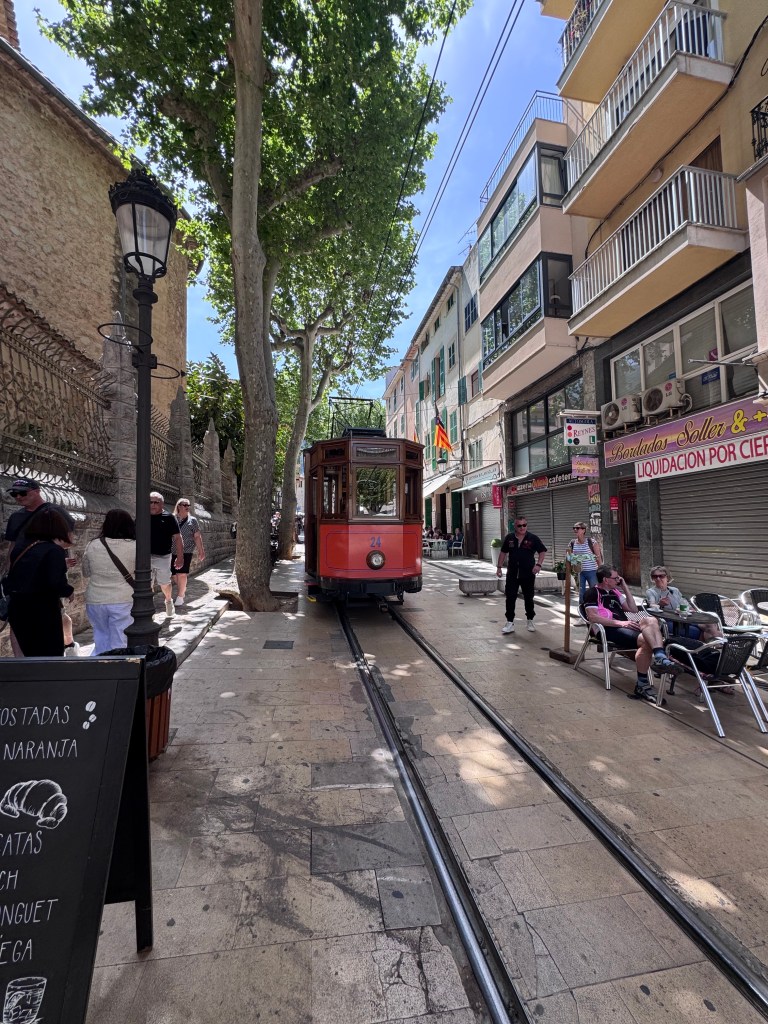
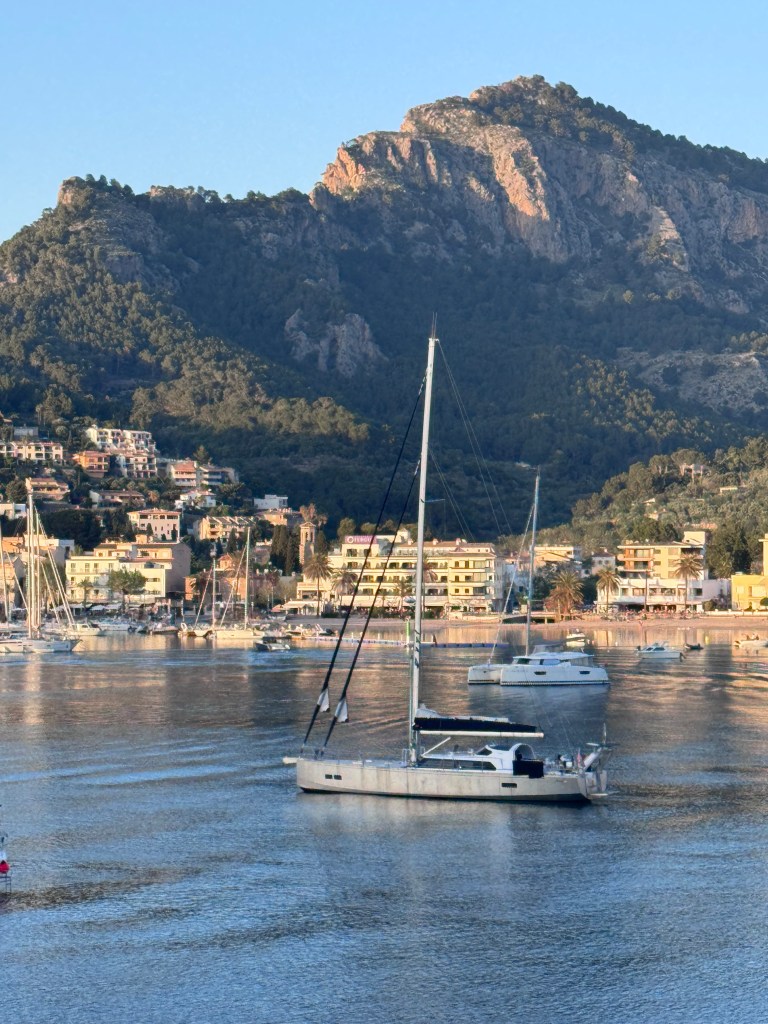
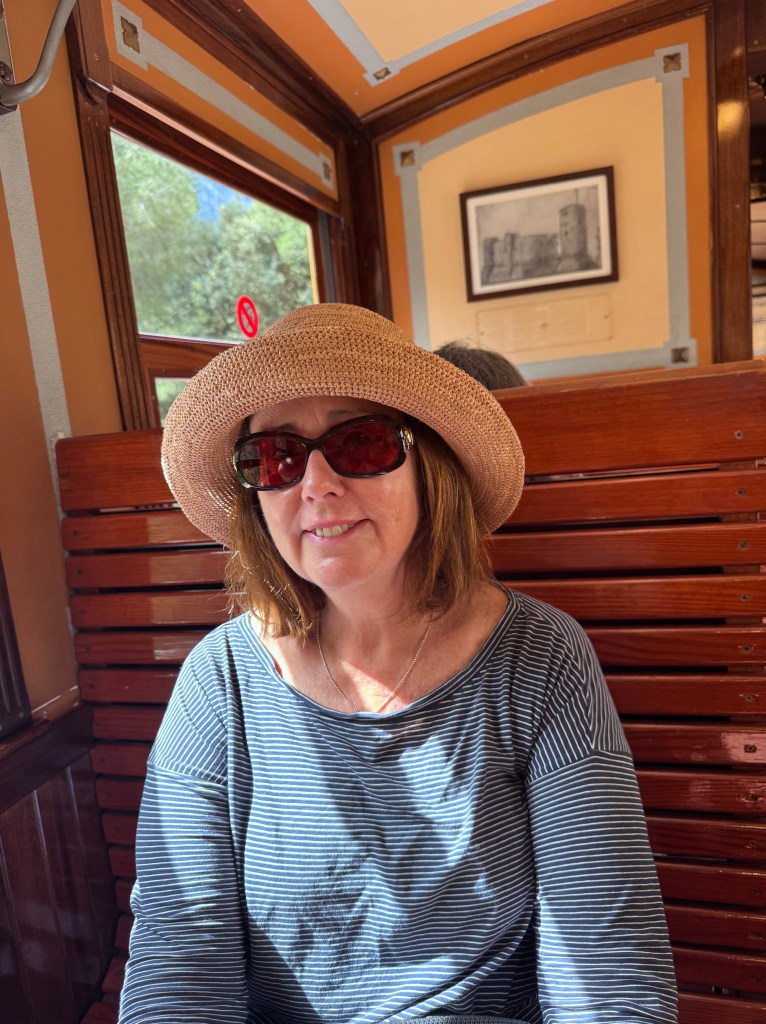
Sóller is its own little world. The bay is round and protected, with a very nice paseo. The main town sits a few miles inland in a valley of orange groves, established away from the coast to keep it hidden from pirates. The way you get from one to the other is on a wooden train that has been making the run since 1912. Polished wood seats. Open windows. Climbing through tunnels and switchbacks, with the orange trees flashing past you. At first you think of it as a tourist trap, but once you board you realize this is the real deal.
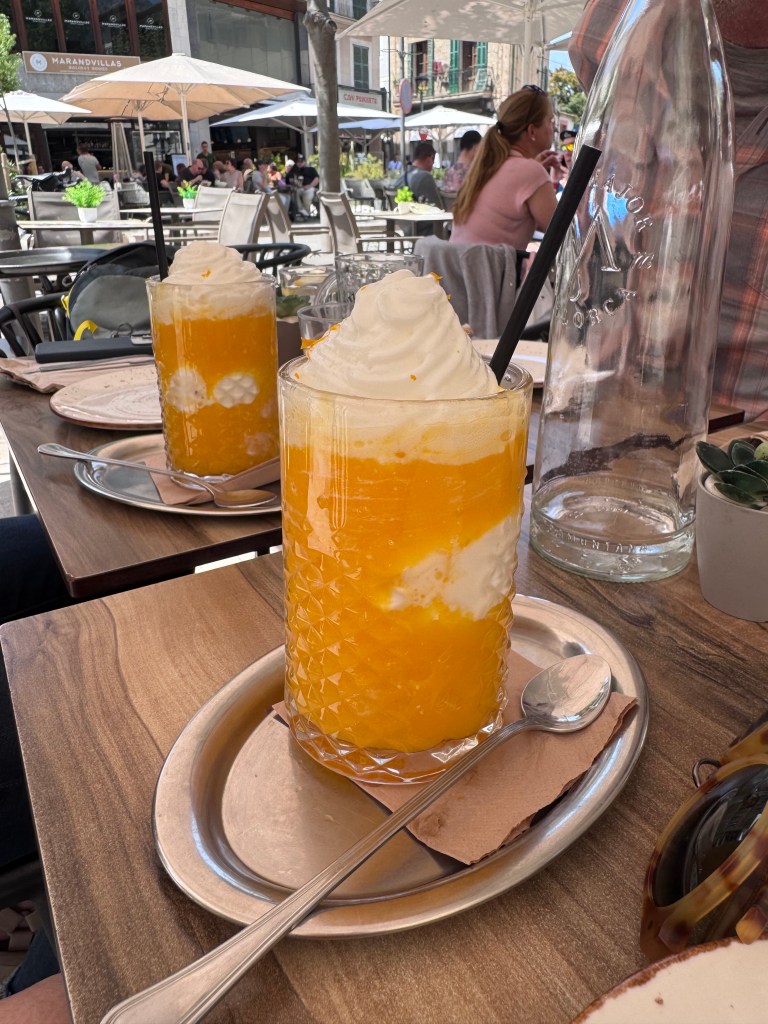
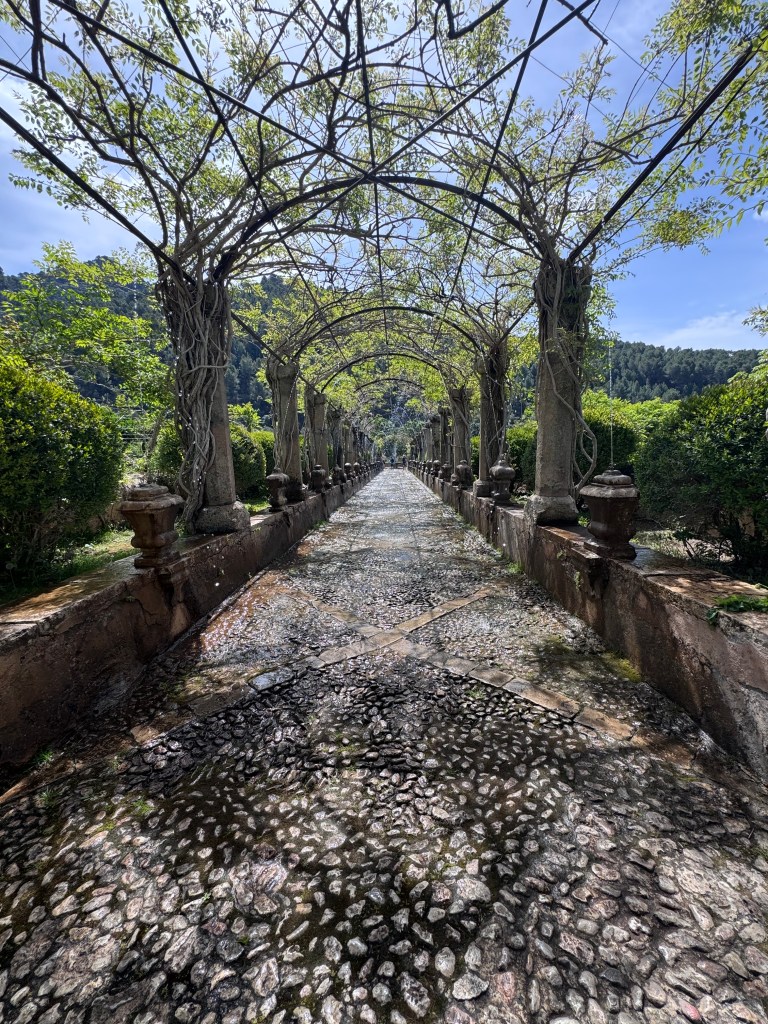
The train stopped in town, and from there we boarded a second train, same wooden wonder, up to Jardines de Alfabia. Alfabia is a 13th-century estate, originally laid out by a Moorish governor, now a maze of terraced water gardens, hidden fountains, and a long pergola that drips with wisteria in spring. We walked the gardens, rode the train back to town, and found a table for wine and tapas. And then there was an Orange Bomb. The recipe: pour four ounces of fresh-squeezed Sóller orange juice over ice and frozen yogurt, add a generous shot of gin (or vodka) and a splash of Cointreau (if you want), blend until slushy, garnish with a twist of orange peel and whipped cream. Tastes like someone concentrated a sunny morning into a glass.
We took the obligatory pictures of Spindrift at anchor in the bay on our way back to the marina front.
The Backtrack, April 23
0550 UTC, 0750 local. Anchor up at Sóller. We pointed Spindrift back south, retracing our route down the west coast. A short sail, a lazy day. This is when Chris got his first test as a member of the crew.
An important article of Rick’s clothing, in a moment of poor judgment, blew off the deck and into the water. Without ceremony, Chris went in after it. Recovered, hung to dry, story made. This may have been Chris’s first real test. He has googly eyes for Julia, and we wondered if the universe was checking whether he fit into the family. If so, welcome to the crew, Chris. I hope there are no more tests.
Playa Estanys, April 24
1329 UTC, 1530 local. Late start. We pointed east along the south coast and dropped the hook at Playa Estanys. Quiet. Sheltered. We lowered the dinghy and walked the beach. We swam, finished three bottles of red, and told hours of stories. Probably fun only for Rick and me. Sarah made chili for dinner. Great chili, Sarah!
The Guest Log
There is a Mercurio family tradition. We have been keeping a guest log since January 19, 2003. Every time we have sailed, with family or with friends, we ask our crew to write something in it. A line, a page, a drawing, whatever they want to leave behind. Some entries are a single sentence. Some run for pages. Some are sketches of the boat, or of the bay we were anchored in that night.
We pulled it out one evening, set it on the cabin table, and went back through the old entries. Handwriting we recognized before we read the names. Stories we had half-forgotten until the book pulled them back up. Rick, Lisa, Chris, and Julia added their pages, as everyone before them has, and the next time we open the book we will find them again. A recommendation to anyone starting out: pick up this tradition. It helps as you get older, like me, and the memories start to fade.
Cabrera, April 25–26
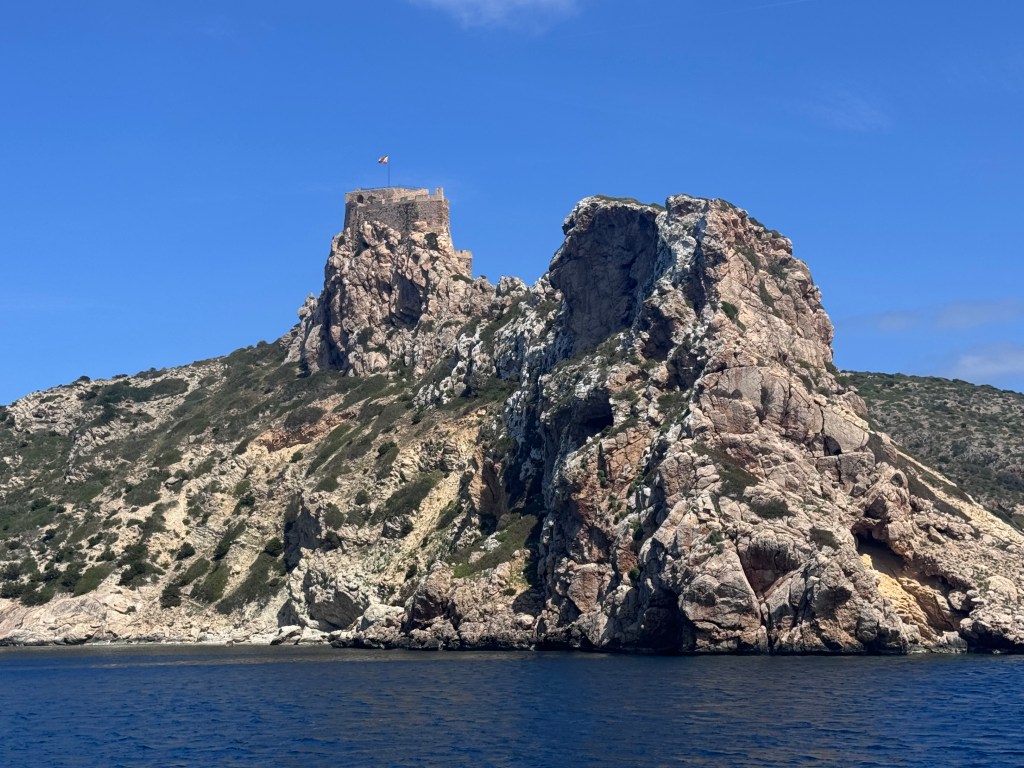
1031 UTC, 1231 local. Hook up. We pointed south for Cabrera, a small archipelago about ten miles off the south coast of Mallorca. Cabrera is the wild card of the Balearics. Twenty-some islands and islets, a single small harbor, almost no human footprint. It was declared a National Park in 1991 and is run accordingly: permit to enter, no anchoring, mooring balls reserved in advance. No reservation, no entry. The result is that Cabrera today looks almost exactly the way it did when sailors first started writing about it. The flora and fauna are back to the original state of these islands.
The history is darker than the postcard suggests. After the Battle of Bailén in 1808, during the Peninsular War, Spain captured several thousand French soldiers from Napoleon’s army and could not figure out what to do with them. The decision was to dump them on Cabrera. Somewhere between five and nine thousand men were left on a small, dry, treeless island with almost no food, no shelter, and a single supply boat that came when it remembered to. They survived on rationed biscuits, rainwater, and whatever they could catch. Most didn’t make it home. The survivors were finally repatriated in 1814. There is a small obelisk on the island today, raised by the French, in their memory. Tough story.
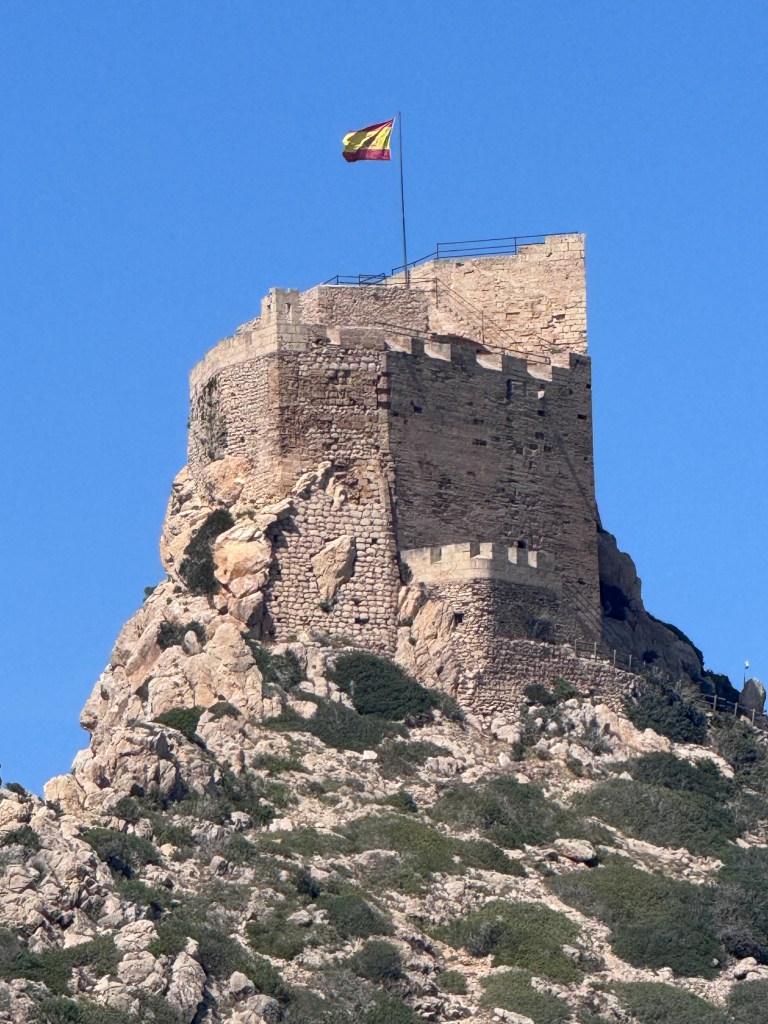
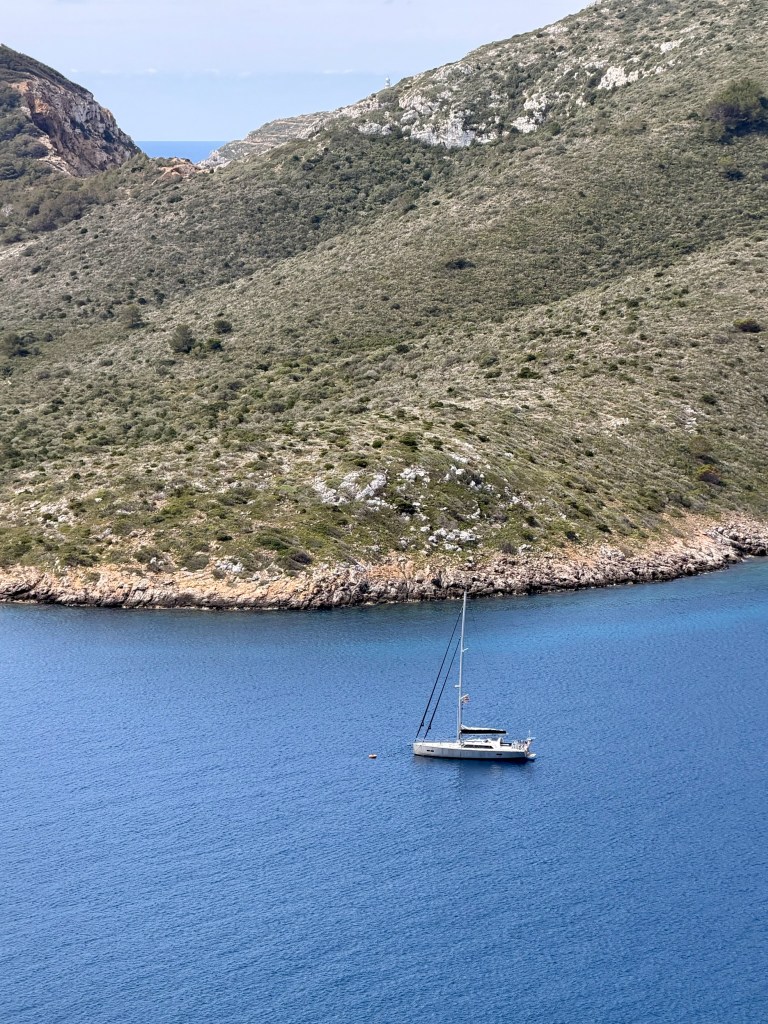
We hiked up to the castle that watches over the harbor. The Castell de Cabrera is a stubby fourteenth-century watchtower built to keep an eye out for North African pirates. The trail is short but steep, and the view from the top is worth every step. Spindrift on her mooring below, the harbor a perfect blue half-circle, and beyond that the open Med stretching south toward Africa.
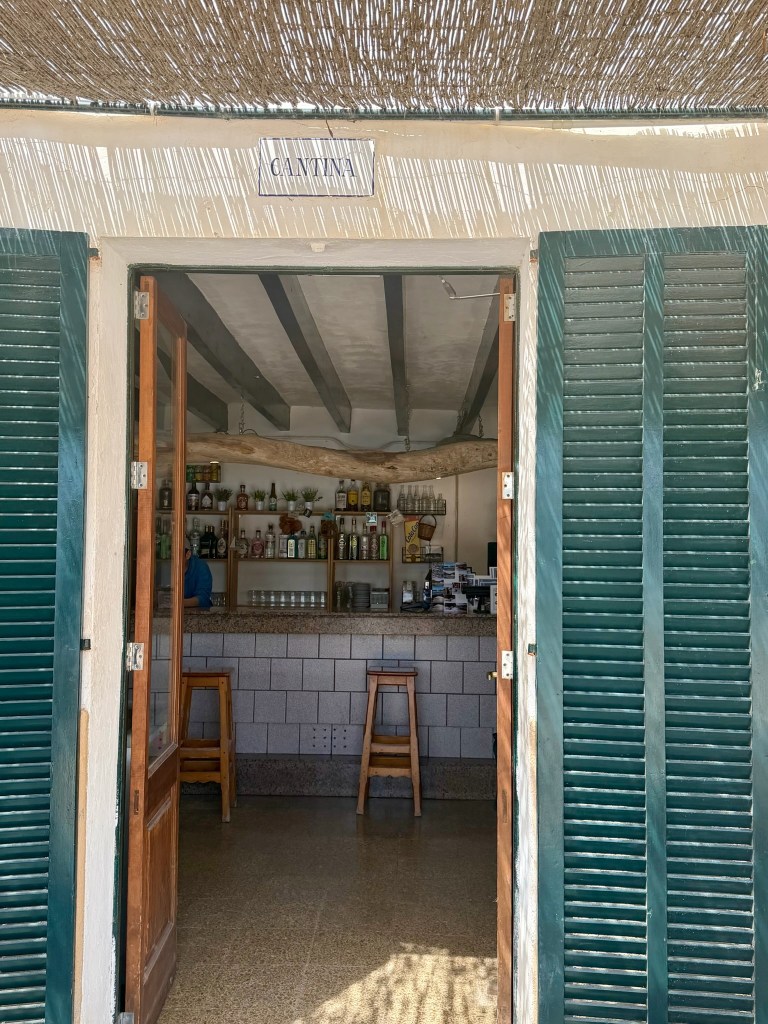
Cabrera’s other claim to fame is the canteen at the head of the harbor. One small kitchen, one cook, one menu chalked on a board. The headline item is a sardine sandwich on crusty bread with tomato and olive oil, and a cold beer to wash it down. We did our duty.
Porto Colom, April 27
0730 UTC, 0930 local. We left Cabrera and finally got a half-decent sail up the east coast of Mallorca to Porto Colom, a deep natural harbor lined with pastel fishermen’s cottages. Mooring picked up, dinner in town, a quiet evening on deck.
S’Arenal, April 28–29
1051 UTC, 1251 local. We departed Porto Colom and worked our way back west, with a stop at Salines de S’Avall before pushing on to anchor off the long beach at S’Arenal, Mallorca’s “Ballermann” coast just east of Palma. On paper, a perfect sweep of sand. In practice, our night there earned a footnote in the log. No wind to speak of, but a stubborn swell rolled into the anchorage all night. Spindrift rolled with it, the rigging tapped, and nobody got the deep, unbroken sleep we had been racking up at the quieter coves. Coffee came early.
Then the walk on the beach. If you have not been to S’Arenal in season, picture every cliché about northern European holidaymaking compressed into a three-mile stretch of sand. Tattoo parlors. Beer halls. A topless beach that doesn’t seem to mind one way or the other. And the Germans. Specifically, the German men in a cartoon working-class uniform: thick gold chains, white undershirts, cargo shorts, bucket hats, gold-rimmed sunglasses. The phenomenon has a name. Germans call it “Malle-Style.” It is the tongue-in-cheek “Bauarbeiter” (construction worker) or “Prolet” look that has been the unofficial costume of Mallorca holidays since the 1990s. Part costume, part inside joke. The whole Ballermann scene runs on the same comedic, ironic energy. Giant beer steins, schlager music blasting from every other doorway, souvenir shops selling foam hats. We walked through it like tourists in someone else’s tourism, which is exactly what we were.
We were ready to be back on the boat by sunset.
Back to Andratx, April 30
The last leg was a short hop back to Port d’Andratx, where the trip had started twelve days earlier. Another flat-calm morning, but the arrival was not.
Andratx is busy this time of year, and our assigned slip was tight. The kind of tight where you measure twice, breathe out, and commit. Mallorca uses Med mooring almost everywhere: you back into your slip, pick up a lazy line forward, and make the boat fast between two neighbors who very much do not want you to bump them. We had wind on the nose pushing us off line, a row of expensive paint jobs to port, another to starboard, and a crowd on the dock that suddenly had nothing better to do than watch.
I took a breath, put Sarah on the bow, Rick and Lisa on the stern, Chris and Julia on fenders. We backed in slowly, picked up the lazy line, missed a neighbor by a fender’s width, walked the line forward, and tied her off. No paint exchanged. A bit of drama. A little help from the marina’s tender. And then a small round of applause from the dock. We will take it.
Saying Goodbye
That last night we went into Palma for a proper dinner, toasted twelve days none of us will forget, hugged, and said our goodbyes. In the morning, Rick, Lisa, Chris, and Julia were in a taxi to the airport, and Spindrift was suddenly very quiet again. Sarah and I stood on the dock and didn’t say much. There was nothing to say.
If you take one thing away from this post, take this. Get your friends on a boat for a week. Make sure they understand it is more like camping with some luxury items than staying at a resort. Make them swim instead of shower, eat from a half-empty fridge, and write in your guest log. Then ask them to come again.
Fair winds from S/V Spindrift


Leave a Reply