
A love letter to the sea’s most glorious weirdo
Sarah and I were heading back towards Mallorca, sailing along at less than four knots, when we saw the first one. A fin sliced through the surface about thirty meters off the starboard side, tall and dark, slightly ragged at the edge. Your mind goes to orca first these days. It always does. Then it rolled over, and we realized we weren’t looking at an orca, or a shark, or a dolphin. We were looking at what appeared to be a giant something, sunbathing on its side.
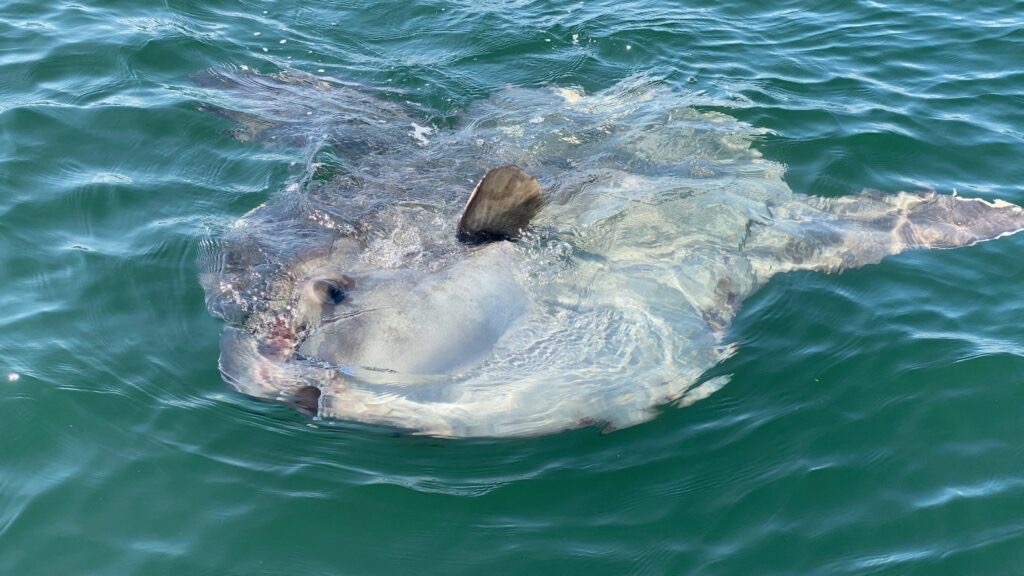
We’ve seen sunfish before, but this one was big. By the end of the day we’d spotted four more, smaller ones, and then a school of juveniles.
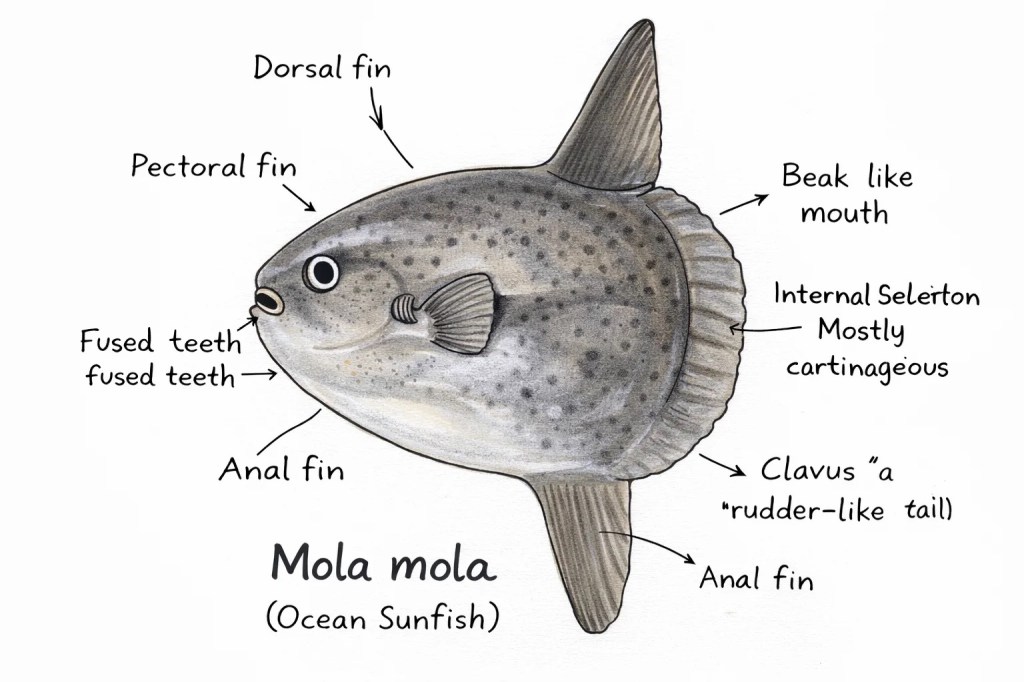
We’ve sailed over 2,500 miles on S/V Spindrift and seen a lot of life in the ocean. The mola jumped the line. The ocean sunfish (Mola mola) is the largest bony fish in the world. They can grow to more than 2,000 kilograms, heavier than a small car, and look like absolutely none of that mass was earned through good decisions. Imagine a fish that started a sentence and forgot how to finish it. Flat, vertical, oval body. Dorsal and anal fins jutting out the top and bottom like awkward little wings. And where most self-respecting fish would have a tail, the sunfish has nothing. Just a frilly back edge called a clavus, sitting where the tail clearly should be but isn’t.
They eat jellyfish, mostly, which is a thing the ocean really needs somebody to do. They dive deep, sometimes more than 600 meters, into bone-cold water to hunt, then come back up and lie on their sides at the surface to warm in the sun and let seabirds pick the parasites off their skin. The “lazy fish floating uselessly” is actually a fish doing thermoregulation and getting a facial.
The one we watched did not seem to care about us in the slightest. One cartoonishly large eye pointed at the sky, the other presumably contemplating the depths, the Mediterranean blue around it making the whole scene look slightly fake, like someone had Photoshopped a manhole cover into the sea.
The mola looks like a fish that was interrupted halfway through being designed, and people have been saying so for centuries. Mediterranean fishermen treated it as a kind of joke, a useless oddity not worth eating or studying. Well into the twentieth century, biologists wrote it off as evolutionary dead weight. They were wrong. The fish has been quietly doing fine for millions of years.
Mola mola is currently listed as Vulnerable by the IUCN. They get caught as bycatch in driftnets and longlines, and they eat plastic bags, which look in the water exactly like jellyfish.
So keep a sharp lookout for these freakshows. In late spring or early summer, with a flat sea and time to watch the surface, look for the lone fin and the rolled-over disc with the gulls dancing around it.
Here’s the thing about defending a fish nobody thinks needs defending: it isn’t asking for much. The mola eats jellyfish. It bothers no one. It is, in the most literal sense, minding its own business floating sideways at the surface.
So slow down when you see one. Don’t run it over. Keep your plastic on the boat. That’s the whole ask. The largest bony fish in the ocean is being killed by plastic bags, and we can do better than that.
Fair winds from S/V Spindrift


Leave a Reply