
Flag Etiquette While Cruising Europe.
This is the Royal Navy’s gin pennant. More on this later.
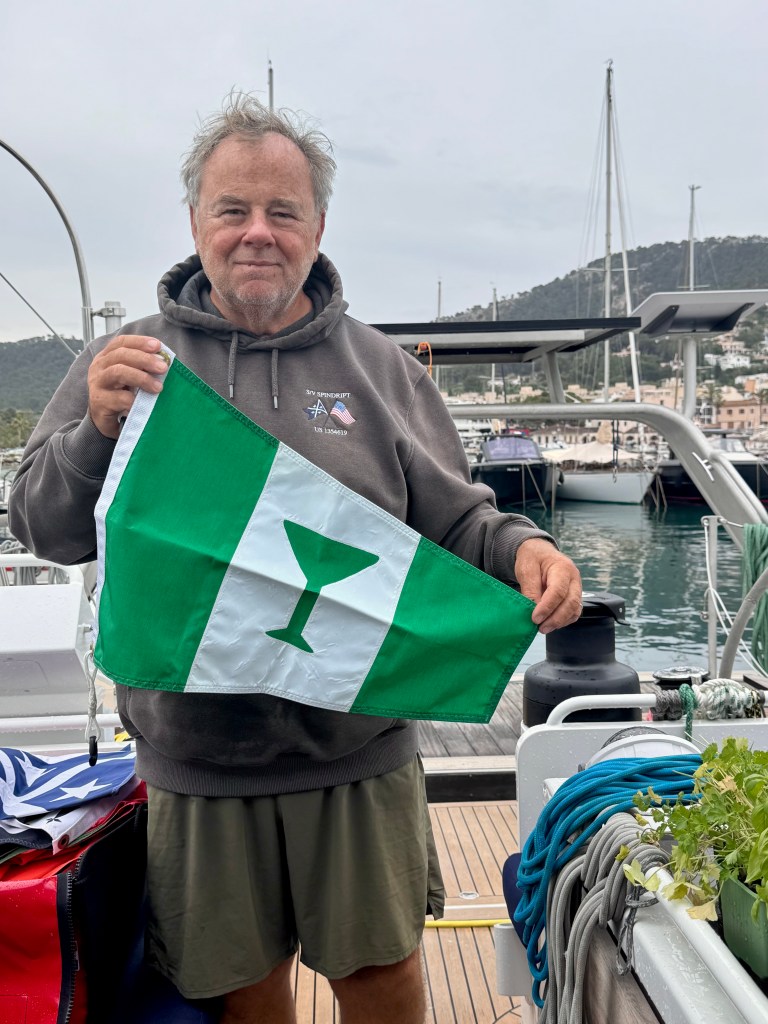
Those that know me know that etiquette is not one of my attributes. However, flag etiquette has caught my attention. So, I went all in.
There is a quiet code to it. Harbor masters see what you are flying. So do customs officers. So do the cruisers in the next slip who have been doing this longer than you have.
Get it right and nobody notices. Get it wrong and you’ll hear about it, sometimes politely over sundowners, sometimes less politely from a customs officer in a RIB.
Here’s how we operate aboard S/V Spindrift, a US-documented boat, cruising the coasts of Europe.
The National Ensign: Your Flag, Your Identity
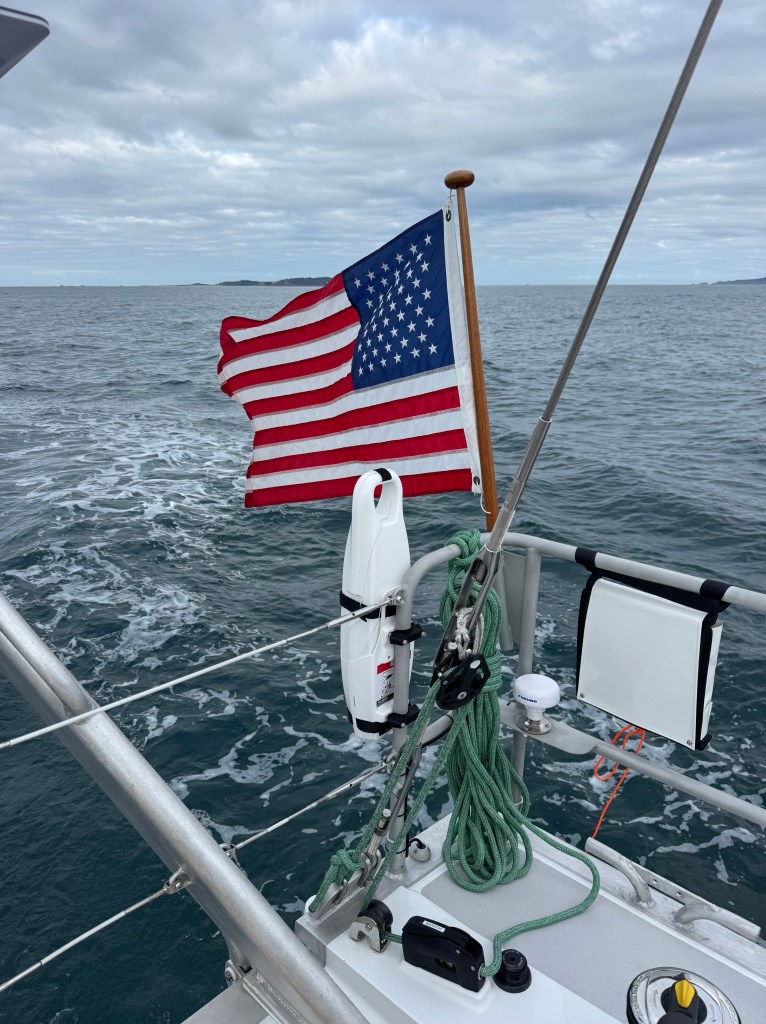
The national ensign is the most important flag on your boat. For a US-documented vessel, like S/V Spindrift, that’s the fifty-star flag. Not the yacht ensign with the fouled anchor. The yacht ensign is for state-registered recreational boats in US waters. If you carry a USCG documentation number, as we do, you fly the national flag. Period.
Where it goes depends on your rig. Under way on a sailboat, the ensign flies from the stern staff. Some boats fly it from the leech of the mainsail, but that’s not a tradition. Yawls and ketch-rigged boats may fly it from the mizzen peak.
The tradition is that the ensign goes up at sunrise and comes down at sunset. We follow it. There’s something about that morning ritual, hoisting the colors with your coffee while the harbor wakes up, that never gets old. And lowering them at sunset gives a shape to the day. Some cruisers leave it flying around the clock, and nobody’s going to arrest you for it, but we think the tradition is worth keeping.
One more tradition worth knowing. When you pass a naval vessel, you dip your ensign. That is, lower it to about two-thirds, hold it until the warship dips hers in return, then raise yours back up. It’s a sign of respect between vessels that goes back centuries. Not every navy responds, but most do. We haven’t had the occasion yet, but it’s on the list. It is going to be a special day when a destroyer dips her ensign in response to a 56-foot sailboat.
The Q Flag: You’re Not Done Yet
The yellow quarantine flag, or code flag Q, tells authorities you’ve arrived from a foreign port and haven’t yet cleared in. The traditional practice is simple. Fly Q alone from the starboard spreader as you cross into the country’s territorial waters and approach port. Once you’ve cleared customs and immigration, lower Q and run the country’s courtesy flag up in its place. More on the courtesy flag in the next section. Q is a request for clearance. The courtesy flag is the acknowledgment that you’ve got it. They don’t fly together.
Leaving Q up after you’ve cleared is sloppy. Not flying it when you should have is an invitation for a conversation you don’t want to have.
In practice, between Schengen countries the Q flag has fallen out of use entirely. Sail France to Spain and no one expects it. Arrive from outside Schengen, Gibraltar or Morocco or the UK, and you fly it. When in doubt, fly it. The worst that happens is someone tells you that you didn’t need to.
The Courtesy Flag: Respect the Country You’re In
This one matters most when you’re a guest in someone else’s waters.
The courtesy flag is the national flag of the country you’re currently in, and it flies from the starboard spreader, which is the highest point on the starboard side.
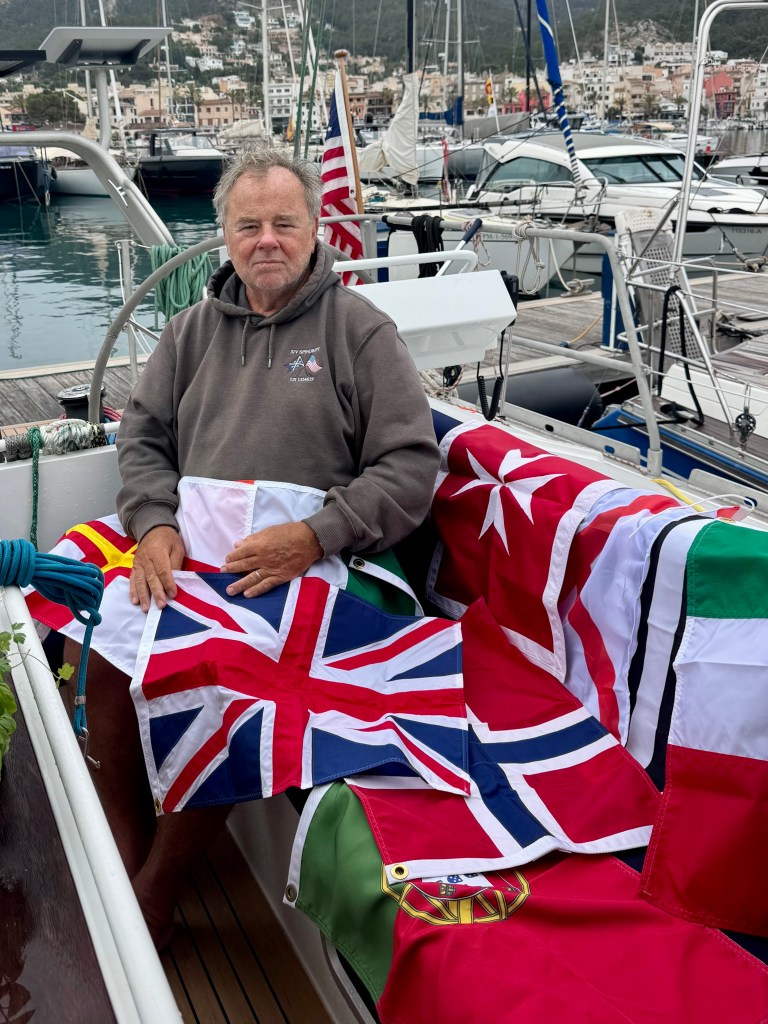
You hoist it after you clear in through customs. And you take it down when you leave. Sailing from Portugal to Spain? The Portuguese flag comes down and the Spanish flag goes up before you arrive. We’ve met cruisers who fly a whole collection at once. Don’t be that boat.
One thing that catches people out: not every territory flies the flag you’d expect. Guernsey and Jersey are Crown Dependencies, not part of the UK. Each has its own flag and you fly it, not the Union Jack. Same with Gibraltar. It’s a British Overseas Territory with its own flag. We’ve flown Guernsey, Jersey, France, Spain, Portugal, and Gibraltar so far aboard S/V Spindrift, and each one gets its own courtesy flag on the starboard spreader. Do the homework before you arrive.
A few practical notes from experience. Buy your courtesy flags before you need them. You don’t want to be hunting for one after you’ve already arrived. Get decent ones. Sewn flags are best. And my source is Adele Bravo from Prestige Flag. She is wonderful to deal with. Reach out and tell her I sent you. adele@prestigeflag.com. A faded, tattered courtesy flag is worse than no flag at all. It tells everyone in the harbor that you don’t respect the country you’re visiting. We carry every country on our planned route and a few extras for the unplanned stops, because there are always unplanned stops.
The Burgee: Who’s Your Club?
A yacht club burgee traditionally flies from the masthead. In practice, most of us have wind instruments and antennas up there, so the burgee moves to a spreader halyard. In home waters, that’s the starboard spreader. But in foreign waters the starboard spreader belongs to the courtesy flag. So the burgee moves to the port spreader. Some traditionalists will tell you the burgee must be at the masthead and nowhere else. Those traditionalists probably don’t have antennas and an instrument cluster up there.
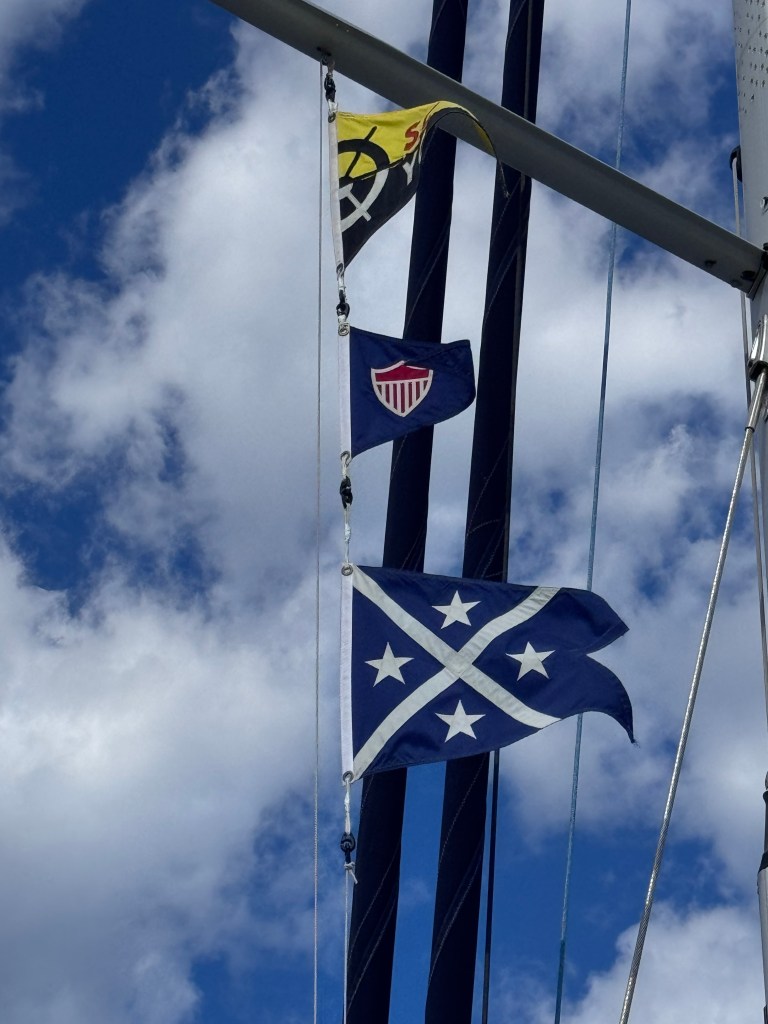
If you belong to multiple clubs or associations, the order on the halyard matters. Highest precedence at the top. Your yacht club burgee goes highest, then any association flags, then your private house flag at the bottom. On S/V Spindrift, we fly the Surf City Yacht Club burgee at the top, the Seven Seas Cruising Association flag below that, and our family flag at the bottom. More on the family flag in a moment. Three flags on one halyard is plenty. This isn’t a used car lot.
One practical note on size. Flags on the same halyard should match each other on the vertical axis. The shapes will differ. A burgee is triangular, an association flag is usually rectangular, a house flag is typically a swallowtail. So the horizontal length will vary, but the heights should agree. A hoist that mixes a small burgee with a much larger flag below it looks off no matter what is on each one. Buy them together if you can, and ask the maker to size them as a set. We try to follow this rule, but not all of our flags match yet — it is on the list to fix.
Swapping Burgees: The Handshake Between Clubs
One of the best traditions in sailing is the burgee swap. When you visit another yacht club, you bring one of your club’s burgees and exchange it with one of theirs. Most clubs display their collection of swapped burgees behind the bar or in the clubhouse. Looks really cool. A wall of triangular flags from ports around the world. It’s a handshake between institutions, and it connects your home club to places it will never sail.
The only swap we’ve made so far was at Monte Real Club de Yates in Bayona, on the Galician coast. We traded a Surf City Yacht Club burgee for one of theirs, and there’s now a SCYC burgee hanging in their clubhouse. It’s a club worth knowing. Monte Real sponsored Spain’s first-ever America’s Cup challenge in 1992, entering España 92 in the challenger series in San Diego. The club sits in the harbor where the Pinta landed in 1493, carrying news of Columbus’s discovery back to Spain. Walking into their clubhouse, you feel five centuries of maritime history on the walls. And now a little piece of Surf City is up there too.
Carry a few extra burgees from your home club whenever you cruise. You never know when the opportunity will come, and it’s a connection that lasts longer than any logbook entry.

When a Club Officer Is Aboard
If you’ve got a past or present commodore or other club officer aboard there’s a protocol for that too. The officer’s flag flies above our yacht club burgee, but only while that officer is actually on the boat. When they step ashore, the flag comes down. It’s a personal honor, not a permanent fixture. Each officer rank has its own flag. You fly the one that matches your guest.
There is some variation on this approach. On the east coast of the US some clubs prefer a more “matched” display. Meaning you must show the yacht club burgee associated with the officer flag you are flying. On S/V Spindrift we take a more traditional approach. Officer flags are tied to the person, not the burgee you are flying. So we do not strike our SCYC burgee when we have an officer on board.
The Mercurio House Flag
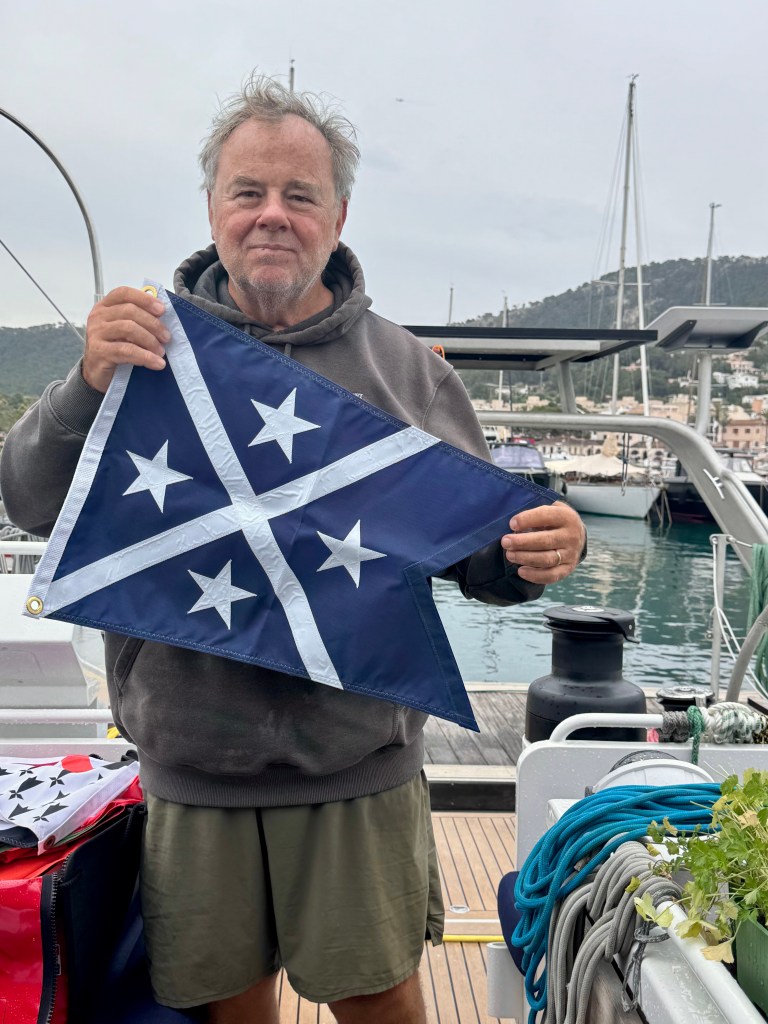
I promised earlier to come back to our family flag, so here it is. The four of us, Sarah, Hannah, Samantha, and me, designed it together. A house flag, sometimes called a private signal, identifies the owner or the family aboard. The traditional shape, especially in the United States, is a swallowtail. Ours follows that tradition.
The design is simple. Signal flag M, a white saltire on a blue field, for Mercurio. Four white stars, one for each of us. We fly it at the bottom of the port spreader halyard, below the Surf City Yacht Club burgee and the Seven Seas Cruising Association flag. It is also the flag that means the most.
Signal Flags: The Ones You’ll Actually Use
Beyond the Q flag, the international code of signals includes dozens of single-letter flags, each with a specific meaning. Most are for commercial shipping and you’ll never touch them. But a few show up regularly in the cruising life.
Alpha (A). Diver down. The blue-and-white swallowtail Alpha flag is the international signal that someone is in the water below. Fly it whenever you’ve got a diver scrubbing the hull, checking the prop, or clearing a line from the shaft. In US waters you’ll also see the red-and-white sport diver flag, but internationally, Alpha is the one other vessels recognize. Keep clear of any boat flying it.
Bravo (B). Taking on or handling dangerous cargo. For cruisers, that means fueling. Some marinas require it, others don’t bother, but it’s good practice, especially at fuel docks where boats are rafted close together. A solid red swallowtail flag that’s hard to miss, which is the point.
You’ll occasionally spot other flags in anchorages and marinas. Papa (P) on larger vessels about to depart, or two-flag hoists for specific messages. But for S/V Spindrift, Alpha and Bravo are the two we tend to fly when needed.
The Solo Sailor: A Flag Worth Recognizing
We don’t carry this flag on S/V Spindrift, but every cruiser should know what it means.
A boat flying numeral pennant 1, the white flag with a red circle, is telling you something important. There is one person aboard. One person sailing, navigating, cooking, keeping watch, and trying to sleep somewhere in between. That red dot is a quiet request for awareness, not sympathy.
Solo sailors also mark themselves on AIS, often adding “Solo” after their boat name, something like “Spindrift, Solo,” so that nearby vessels checking their screens understand that the person at the helm might also be the person catching a twenty-minute nap below. They might not respond immediately on the radio. They might not see you as quickly as a fully crewed boat would.
None of this means a solo sailor is less capable. Some of the best seamanship out there happens singlehanded. But if you spot that red circle on a white field, or see “Solo” on your AIS display, give that boat a little extra room. A wider passing distance. A longer look before you cross ahead. It costs you nothing and it might matter a great deal to the person on the other end of it.
Regional Flags: The Courtesy Behind the Courtesy
Here’s one that catches people off guard. In some parts of Europe, flying the national courtesy flag isn’t quite enough. Certain regions have strong identities and their own flags, and locals appreciate seeing them on your spreader.
In France, Brittany is the obvious one. The Gwenn-ha-du, the black-and-white Breton flag, is a point of fierce pride, and you’ll see it on boats, buildings, and bumper stickers from Brest to Vannes. We flew one sailing through and it earned us more than a few nods. Corsica will be another. The Moor’s Head flag is everywhere on the island, and flying it earns you goodwill in every harbor.
In Spain, the regional identities run deep. Galicia has a white flag with a diagonal blue stripe, and the Galicians have their own language and a quiet regional pride that runs as deep as their rías. We flew the Galician flag and it was well received. The Basque Country has the Ikurriña, a red, green, and white flag that was banned under Franco and only became official again in 1979. We flew it in Basque harbors and it means something. People notice. Catalonia has the Senyera, four red stripes on gold, one of the oldest flags in Europe. The pride there is intense, especially around Barcelona and the Costa Brava. Stick with the traditional Senyera, not the Estelada (the independence version with the blue triangle and star) unless you want to make a political statement. The Balearic Islands fly a variation of the same Senyera stripes with a purple canton and white castle. This is a nod to the old Kingdom of Mallorca.
You’re not required to fly any of these. But it shows you’ve done your homework and you respect the place as more than just another stop on the chart. Where the regional flag goes depends on whose tradition you’re following. British and US cruising guides put it on the port spreader, leaving the starboard spreader clean for the national courtesy flag alone. The local Spanish convention is to fly it on the starboard spreader directly below the national flag, on the same halyard. Both are correct. When in doubt, do what the locals do. In Spain, that’s starboard-stacked. You’ll see Spanish national above Balearic, Catalan, Basque, or Galician on every other boat in the harbor. In France, the Gwenn-ha-du is typically flown on the port spreader rather than stacked.
On the Stars and Stripes
A note on our own flag, since people ask. American boats are less common in European waters than you might expect, and people are curious. A clean, properly flown ensign starts good conversations. A tattered one starts the wrong ones.
We fly the Stars and Stripes proudly. It’s our flag. It doesn’t belong to any president or political moment. It represents us, our country, and generations of Americans who sailed under it before we did. Every time I raise and lower it, I think about my father, who served in the Navy and was stationed in England during World War II. That flag meant something to him then, and it means something to me now.
That said, we’re not naive. In certain ports and certain times, the political climate back home casts a long shadow. So, we try to read the room. There are places and moments where we’ll quietly take it down to avoid provoking a reaction that has nothing to do with us or our boat. In Tréguier, on the north coast of Brittany, we were tied up at the dock when a protest came through town. We weren’t sure what it was about, but we didn’t need to know. We took the flag down until it passed. No drama, just common sense. It’s not shame. It’s seamanship. You don’t sail into a squall when you can tack around it.
What We’ve Learned the Hard Way
Small harbors care more. In big marinas in France or Spain, nobody’s inspecting your flag hoist with binoculars. Pull into a fishing village on the Algarve or a small port in Galicia and people notice what you’re flying and how you’re flying it. That’s not a burden. It’s a compliment to the place.
Don’t overthink it. Flag etiquette has centuries of tradition behind it, and there are people who will argue the finer points until the ice melts in their gin. The basics are simple. Fly your ensign. Fly the right courtesy flag in the right place. Fly Q when you need to. Take everything down when it’s done its job. That covers 95% of situations.
Getting the Order Right
Here’s the hierarchy on a sloop, top to bottom.
Starboard spreader: the position of honor. Country courtesy flag at the top. When in Spain, France, or other countries with strong regional identities, the regional flag goes directly below the national on the same halyard. Q flag flies here alone before customs clearance, then comes down once you’re cleared.
Port spreader: yacht club burgee at the top, then any association flags, then your house flag. In British and US tradition, the regional flag also lives here. Either approach is correct. When in doubt, look around the harbor and follow the locals.
Stern staff: national ensign.
The underlying principle is simple. The position of honor is the highest point on the starboard side, and it always belongs to the flag of the country you’re visiting. Your own flag is important, but you’re a guest. Act like one.
The Best Flags Come Last
After all the protocol, the customs flags, and the signal hoists, the two best flags in sailing have nothing to do with any of it. These flags are flown in a traditional manner below the courtesy flag on the starboard spreader. The starboard spreader is considered our “social” side.
The first is the dinner flag. A plain white flag flown to signal that a meal is being served aboard and the crew would rather not be disturbed. It’s a polite way of saying “we’re eating, come back later.” Simple, civilized, and deeply practical when you’re anchored in a social anchorage and your pasta is getting cold.
The second, and arguably the most important flag in all of cruising, is the gin pennant. Remember the green pennant from the photo at the top of this post? That is the one. Originally a wardroom prank in the Royal Navy, hoisted by junior officers to signal “come over to our mess for free drinks at the senior officers’ expense.” Cruisers adopted it as a less mischievous open invitation. When you see one flying in an anchorage, you grab a bottle and your dinghy. When you fly one, you’d better have enough ice.
There’s a quiet pride in getting your flags right. When you pull into a new harbor flying the right courtesy flag, clean and bright, from the starboard spreader, your ensign crisp on the stern, it says something. It says you care. It says you’ve been paying attention. It says you understand that sailing to another country is a privilege, and you’re honoring it the simplest way a sailor can.
But at the end of the day, the flag that seems to matter most is the one that brings your neighbors over for a sundowner. That’s not protocol. That’s cruising.
Fair winds from S/V Spindrift


 S/V Spindrift
Leave a reply to Anthony Mercurio Cancel reply