
Sam, Hannah, Sarah and I are anchored in Sa Calobra, on the north coast of Mallorca. Hannah’s friends Liv and Jordon flew in to join us. Six souls on board. It is one of the prettiest places I have ever dropped a hook. The cliffs of the Serra de Tramuntana rise straight out of the sea, hundreds of meters of pink and gray stone, and the cove is empty except for S/V Spindrift. The water is a weird blue, and you can see the chain along the bottom to the anchor. You cannot get to this place by car. No other masts in sight. Just us, the rock, and the last of the light.
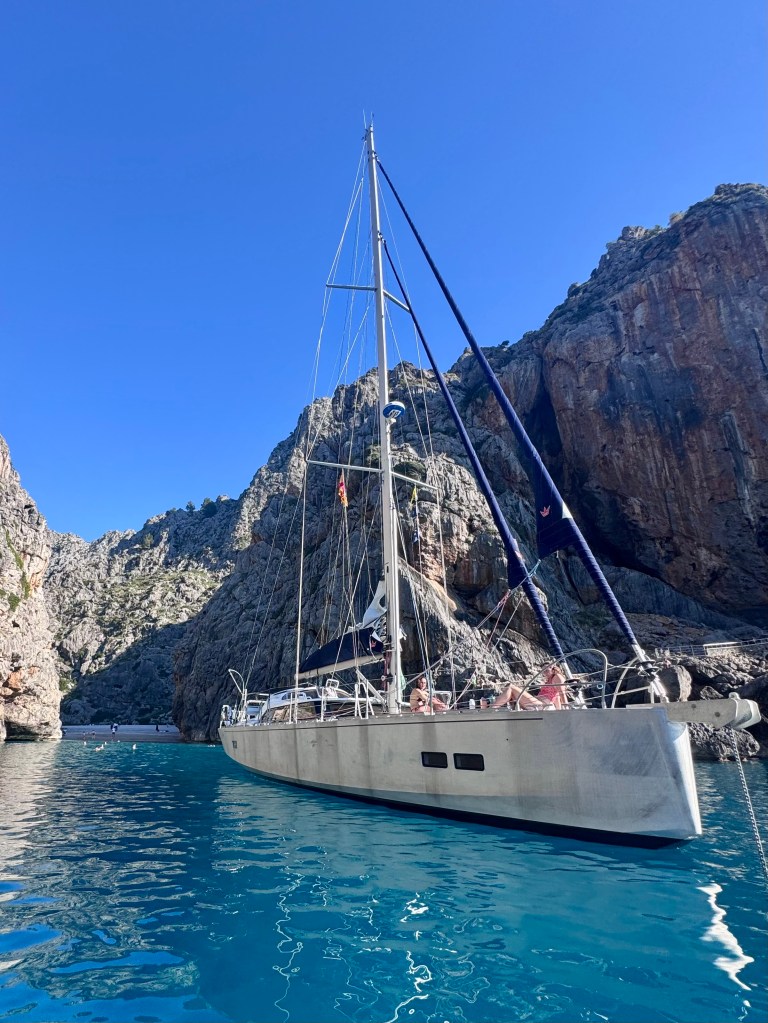
Tonight we stern-tie S/V Spindrift. That close to the rocks, you don’t trust the swing alone. We carry two long warps, 150 meters each, of UHMWPE (ultra-high-molecular-weight polyethylene), and the tackle to make them fast to a rock or a tree ashore. You have to be careful running them out. You don’t want to clothesline anyone in the dark, so we clip chem lights to the lines.
A day at anchor on S/V Spindrift is two things at once. It is a long string of tiny ceremonies, all performed for the express purpose of preventing Mother Nature from turning your floating home into an expensive artificial reef. Weather checks. Anchor checks. Chafe checks. The constant low-grade worry. And it is a long string of small gifts she hands you in return. A school of bream under the boat at sunrise. A swim to shore where you find wild rosemary and thyme for tonight’s chicken. A sunset of a million shades of pink from Saharan dust still drifting in. The eyes that catch a chafe spot on a line are the same eyes that catch the limpets glittering on a rock at low tide. The attention you sharpen to survive her is the attention she rewards. After a while you stop being able to tell the difference. The boat is still floating, and there’s dinner. You earned it.
Here’s what one day at her mercy looks like.
I usually wake up in whatever I slept in: wrinkled shorts and a shirt stained from last night’s dinner, eaten in the cockpit while I was getting tossed around. I cannot remember the last fresh water shower. A swim is good enough. The first inventory of the day is the one I take of myself: it’s a good morning if there are no new aches or pains.
You look at the bridle. You look at the chain. You look suspiciously at the wind. Then you stand there for about thirty seconds and casually inspect the horizon and the other boats that came in late last night, like an old salt squinting at a sky he’s seen before, even though five minutes earlier you were a man-shaped pile of laundry asleep in your bunk.
The sky is doing the impossible pink thing it does here in the Balearics at dawn, and you stand there watching while the real show goes on above you.
Then comes the weather check. And then, immediately, another weather check. By the second look, the forecast has become emotionally important. You will check it three more times in the next hour, and at no point will any of the numbers have changed. The clouds will not have moved. The wind will not have shifted. This does not deter you. You want to know if the day is going to kick your ass, or whether you’re in for a lazy reach to the next anchorage.
You check this much because she gives you signs and your only job is to take them. A swell from a direction it has no business coming from. A distant black cloud on the horizon that might bring a squall. The birds moving inland before you can see why. The boat does the same thing. You feel the wind shift before you see it shift, because the boat tells you first. The hull starts a roll in an odd direction. A halyard ticks against the mast in a way it didn’t an hour ago. You learn to live by these signals. Last thing you need is to be caught against a lee shore. And today we are less than 50 feet from the rock wall.
By now you have earned coffee. The inspection turns serious.
Deck walk. Rig check. Anchor check. Chafe check, because chafe is patient and chafe is forever. A look over the side at the chain, where it disappears into water that is either green or blue depending on what kind of bottom you’re hooked to. Bilge check. Then weather. Then weather again.
By nine in the morning you have walked the same fifty-six feet of deck four times and confirmed that nothing has changed since last night. This is not wasted effort. This is the price of admission. The day you skip the rounds is the day you find the line just about to chafe through, and there is no faster way to ruin a sailor’s morning than the words you should come look at this.
The underwater version comes later in the day, once the sun has lifted high enough to warm the cove. Mask and snorkel over the side, a slow lap around the hull, looking for missing zincs and anything that’s grown a beard since last week. Same chafe check, different element. In water this clear and this warm, it’s the cleanest job on the boat.
Sailing is physical in a real-world way. Your body has to work because something needs doing, and if you screw it up, something breaks or someone gets hurt. Hauling a line. Diving on the anchor to make sure she set. Wrestling the 85-pound Yamaha 9.9 off a dinghy thrashing in the swell and up onto the deck before a blow. Flipping the dinghy over on the foredeck to get ready for the next passage. Climbing the mast to make sure the fittings are all there. The work has weight because the outcome does.
What She Gives
And then, for all this checking and counting and worrying, she pays you.
Not on a schedule. Not on demand. But she pays.
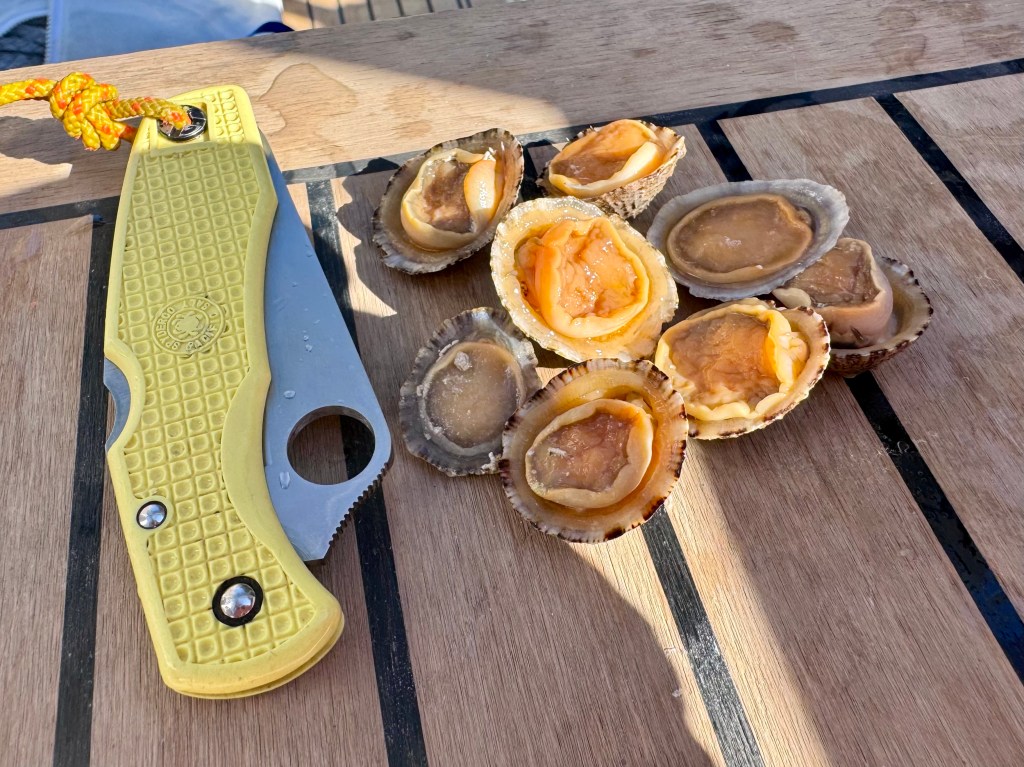
I go for a swim earlier in the day and find the limpets waiting in the crevices, gleaming wet and packed in like coins. I pry them out with the same knife I use on rigging. I bring a bag back to the boat, steam them open with a splash of white wine and some of the wild garlic I found on the path, and that is dinner.
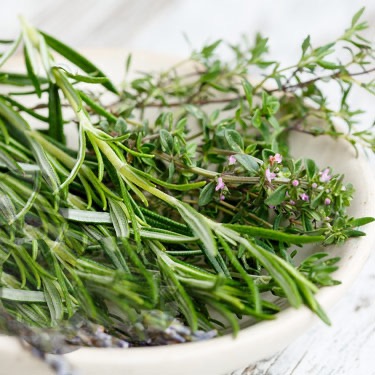
Walk a hillside in the back of a Mallorcan cove and there is rosemary growing out of the cracks in the dry stone. Thyme. Wild fennel taller than you are. A bay leaf off a tree if you know what you’re looking at. Wild onion if you know where to dig. You pick what you need for tonight’s chicken and the galley smells like the hillside for two days.
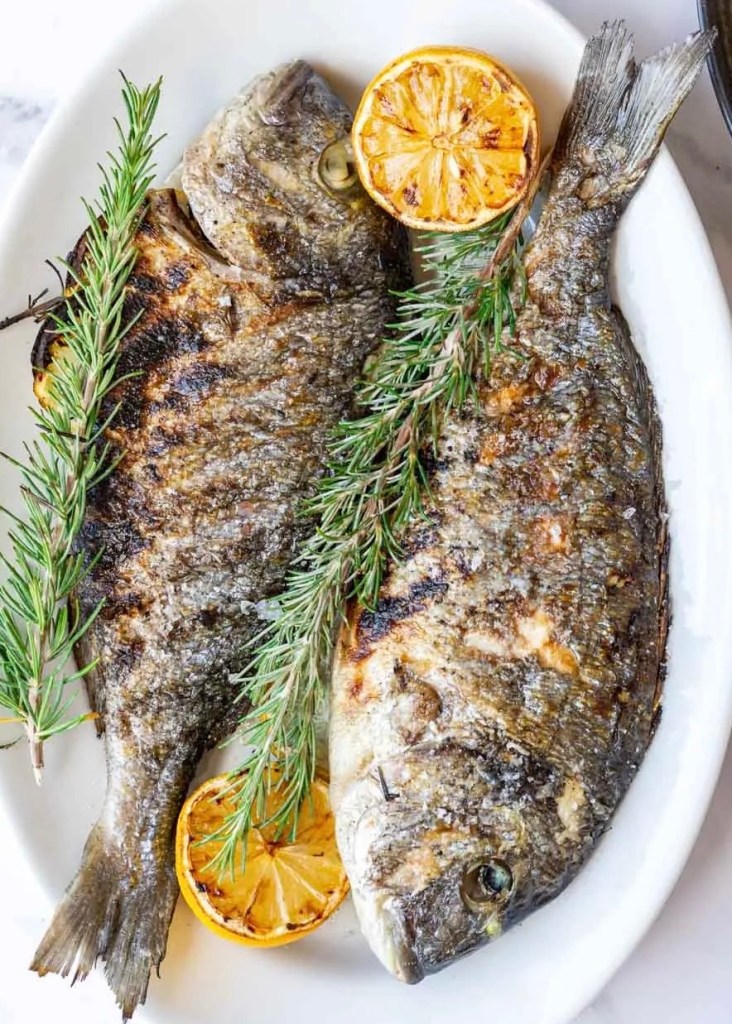
Then there is the spearfishing. You drop into water so clear it doesn’t look like water, sling in hand. Half the time the fish see you before you see them and you come up empty. It doesn’t matter. You were down there in the cold blue silence with the light bending around you, and that was the point. Other days a saddle bream lays itself out in front of you like it had an appointment and you have lunch.
This is a different kind of attention than the chafe check. It is the same attention. The eyes that catch a line about to part also catch a school of fish moving through the anchorage at first light. It’s the same set of eyes.
The supermarket version of dinner is cheaper, faster, and usually tastes better. This one tastes like you earned it. You showed up. She handed you something. Tomorrow she might hand you nothing. That’s the deal.
Sundown: Strike the Colors
At sunset, the ensign comes down. It is the one ritual on the boat that has nothing to do with safety and everything to do with marking that you got through another one. You hoist it with coffee. You lower it with whatever you’re drinking that isn’t coffee. The light on the water at that hour is the reason half the photographs in the world exist, and you have it to yourself.
Out here time belongs to the sky. You measure it in big chunks — sunrise, sun at its peak, sunset, dark — and you lose track of what day it is, because which day it is no longer matters. What matters is whether you’ll have daylight to deal with the next thing, or whether you’ll be doing it in the dark. Your week is shaped by weather windows, not Mondays. Noon is not a time on a watch, it is when the sun is at its peak and at its hottest. The flag goes up and comes down with the sun, and that is all the schedule you need.
And it’s not just us. Plenty of cruisers see life out here the same way. That common bond is what brings most of us together. Tonight we get a call from our friends on M/V Saltaire. It’s been a while. We chat up the summer on LBI. Angie and Dixon are on anchor in the Exumas, out there hearing the same kind of quiet on the other side of the chart, 4,300 nautical miles away on a great circle course. We’re chasing limpets and bream; tonight she handed them a sea monster. On M/V Saltaire they’ll be having a wonderful dorado dinner.
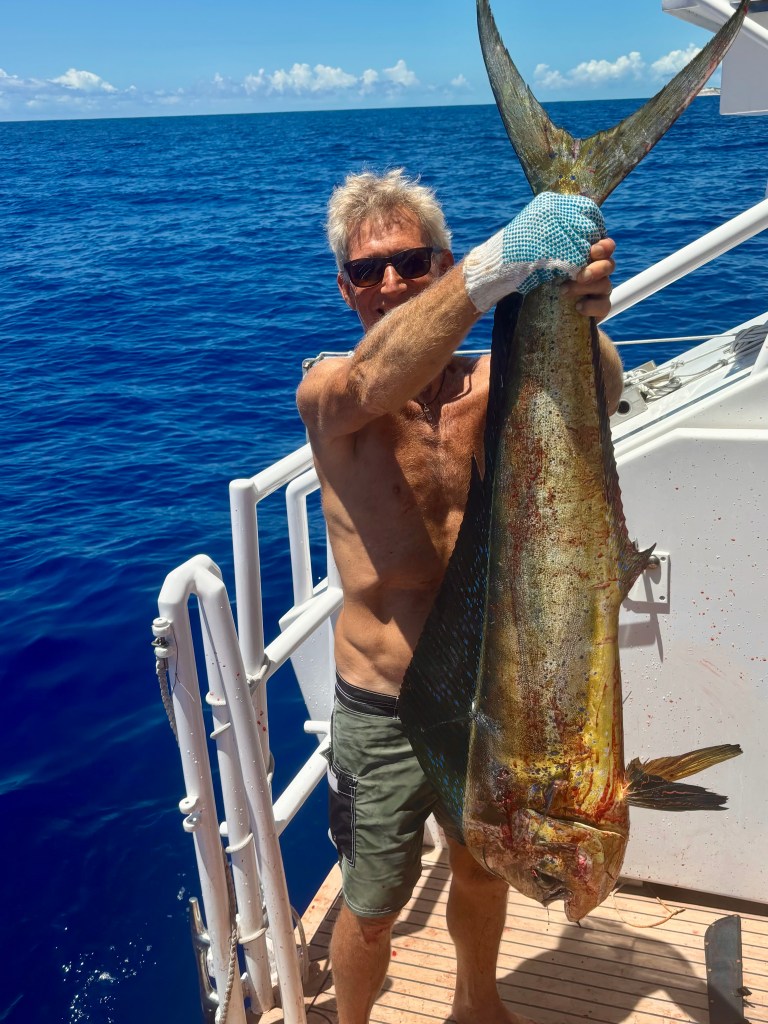
Then the evening rounds begin. Before and after a dinner of limpets, saddle bream, or chicken, the inspection resumes. Deck walk. Rig check. Anchor check. Mental notes on bearings to known rocks, in case, in the dark, the boat decides to go somewhere it shouldn’t. Bilge check. Weather. Weather again. The forecast is once again emotionally important.
By bedtime, Sarah and I have each looked at most systems at least once. We’ve both stepped on deck in the dark and confirmed, with great seriousness, that S/V Spindrift has not moved six inches in the last three hours. We’ve both quietly wondered whether that sound has always existed, or whether tonight is, finally, the night something expensive breaks. We don’t say any of it out loud. We trade the boat back and forth in glances and small nods that say your turn, my turn, we’re good, then meet back in the cabin to say goodnight to each other and to her.
Three A.M.
This night was peaceful, but on some nights you sleep with one eye open. You wake up with your Petzl headlamp still on your head. Every sound out of the ordinary wakes you up. Draws your attention.
On most nights, no one stands a watch. The boat takes care of itself, and we sleep. But the handheld VHF stays on a clip by the bunk, and the headlamp stays within reach. If Mother Nature demands a watch, we’ll stand one. We hope she doesn’t ask.
Why We Do It
You can read all this and decide that I’m a masochist. You wouldn’t be entirely wrong. This is not a luxury cruise where you’re led around like a child. But this is why we do it.
Boats sink quietly. They drag at three a.m. Lines chafe through at the worst possible angle on the worst possible tide. The rituals are not paranoia. Each one buys you a little more luck.
And here’s the other thing. The attention that costs you sleep is the same attention that hands you the rosemary, the limpet, and the bream. It is what lets you see the dolphins at first light before anyone else is awake. It is what delivered a beautiful dorado to Dixon and Angie.
That’s the deal. Comfort for presence. You give up the thermostat and the grocery store. You get the wind on your face, dinner you pulled out of the rocks, and a sky you can’t look away from.
Once you’ve lived this close to her, you don’t want to go back.
Then you check the weather.
And then, of course, you check the weather again.
Fair winds from S/V Spindrift


Leave a Reply