
What forty-one years of managing other people’s risk taught me about everyone except myself.
September 14, 2026
I’m writing this at anchor off the Îles de Lérins, a mile and a half from Cannes and about sixteen centuries away from it. Sainte-Marguerite off the bow, Saint-Honorat off the stern, and on Saint-Honorat a working abbey with vineyards, where monks have been quietly getting on with it since the fifth century. They make a very good wine, and nobody over there is waiting on an email from a boatyard. I am.
We got her back on the thirteenth. Eric, Antoine and Denis had her for boat show week, which is the one week a year somebody else worries about how she looks, and she has never looked better and never will again. Naturally there is nobody out here to see it.
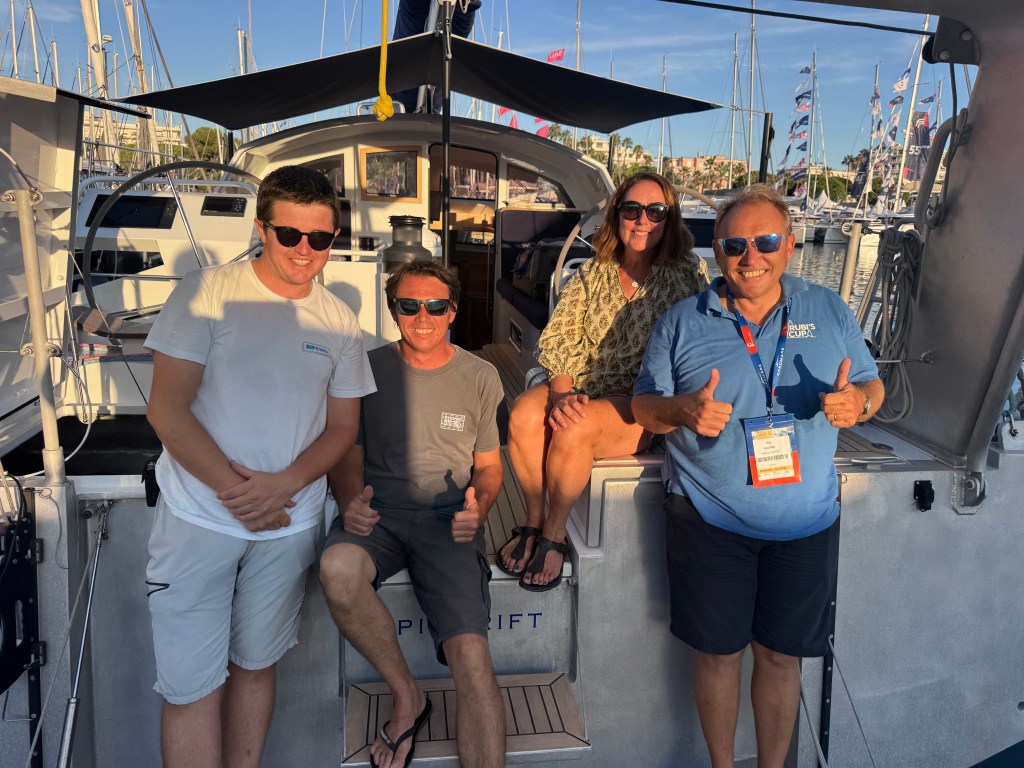
(Photo: Antoine, Denis, Sarah and Eric, left to right.)
The alarm is set for four. I agreed to four at eight o’clock last night, with a glass of rosé in my hand, which is when I agree to most things. Pulling the hook in the dark is what buys the daylight at the other end, and if it goes the way it should we make the harbor in Corsica before dark tomorrow. First leg of the season.
A few of you have asked, more than a few actually, how we get ready for a season. I answered part of that in the spring, in a post about the Yanmar and the feathering prop and the shaft seal, and I stand behind every word of it. But that post told you what’s under her floorboards, which isn’t quite what any of you asked. You asked how we get ready. Same words, different question entirely.
LISTS ON LISTS
Here’s what season prep actually looks like, since I keep dodging the literal version of the question. It isn’t two checklists. There’s the pile that shuts a house down and the pile that gets a boat ready, and then there’s one that gets Hannah off to school and another that gets Sam off to school, two calendars that have never once lined up with each other, let alone with the boat. There’s a spreadsheet of the provisions and parts that have to reach the boat from New Jersey in a suitcase, because you cannot buy some of it in a French chandlery. There’s another for how many days we’re allowed to stay in a Schengen country, and another for when the boat’s temporary import clock runs out, neither of which cares in the slightest what the weather’s doing. And yes, I keep a Gantt chart going. Exactly what you’d expect from a consultant, right?
Most of it isn’t mechanical at all, which is the opposite of what your questions assume. It’s email and research. Routes and the weather behind them, studied months before anyone gets wet. Pilot books that tell you what the charts won’t, which anchorage actually holds and which one empties out the moment the wind backs. Coast Guard incident reports, which I read more than is probably healthy, on the theory that other people’s mistakes are cheaper to learn from than my own. Finding a spot to pull S/V Spindrift out this winter in Sardinia has been its own small saga, conducted entirely in Italian. One yard took a look at her beam and said, politely, that she’s wider than their travel lift can handle. A second, out on Sant’Antioco, took four months to produce a quote, let us accept it, and then wrote this morning to say they have no space of her size after all. A third, ten kilometers away in Carloforte, also took four months to answer and thinks he is nearly full. Two languages, neither of them mine, and the only line I can read cold in either one is the number at the bottom. You’d think, given that I spent a career doing exactly this kind of coordination for a living, I’d have it wired by now.
THE CONSULTANT WHO CAN’T CONSULT FOR HIMSELF
Here’s a fact I don’t love admitting. I spent forty-one years at Marsh & McLennan telling some of the largest companies on earth how to think about risk. Probable maximum loss, return periods, attachment points, what to retain and what to transfer onto somebody else’s paper. Nobody ever sat me down and confirmed I was any good at it. They just kept asking me back, which I have chosen to read as a yes. For a long time I told this as a story about knowledge that evaporated somewhere between the conference room and the dock. It didn’t evaporate. It transferred perfectly, every single time, to everyone except the one client I never once sat down across the table from. The dividing line was never between professional and personal. It runs between somebody else’s skin and my own.
There’s a second version of the same gap, and this one’s arithmetic. My friend Jeremy at Willis knows it cold. Everything I did at Marsh worked because it was aggregated. Thousands of losses, a loss curve, the law of large numbers quietly doing the heavy lifting under every recommendation I ever made. You don’t have to be right about any single loss. You have to be right across enough of them, and the math forgives the misses. A passage is an n of one. There is no return period for the night you personally are having. Actuarial thinking was never built for a single irreversible decision, and it wasn’t coming to sea with me.
I’m not the only one aboard who came out of that world. Sarah spent thirty-five years at Marsh doing the same work I did, which means S/V Spindrift is crewed, on any given passage, by two people with the same training and very nearly the same instincts about what could go wrong. She isn’t reviewing my case and looking for holes in it. She’s making her own call, on her own read of the weather and the gear and the state of the two of us, and she has usually gotten there before she’s heard a word of mine. I’d tell you the record between us is about even. It isn’t. The difference was never skill. She worked out a long time ago who her client actually is out here, and she has been doing the job for her ever since. I’m only arriving at that now, which is most of why I’m writing any of this down.
Two occasions still visit me at inconvenient hours.
THE TWENTY MILES YOU DON’T FEEL
This one is meaner, because there was no waiting it out. Just me and the boat’s owner, running offshore overnight between Mount Desert Island, up in Maine, and Provincetown, at the end of Cape Cod, navigating by Loran C, which for anyone under fifty is roughly what GPS replaced. Loran needed a correction, an offset, that changed depending on where you were, and that far north in Maine the offset actually mattered. I knew this. I skipped it anyway, the way you skip the thing you’ve been warned about but never personally watched fail.
It was the middle of the night, and thick with fog. Then we came to a dead stop. Not a bump. A stop. We were lucky in the only way that mattered, which was that it was flat calm, with no sea running to lift us and drop us onto anything. What I remember is being less frightened than baffled. How could we be on a rock? The chart in front of me put us twenty miles from the nearest one. Then we looked over the side, and there it was, and there were more of them in every direction we pointed the boat.
We were at least twenty miles west of where we thought we were, which isn’t a rounding error. It’s a different ocean than the one on the chart in front of me. We’d been running a plot all night that was internally consistent and completely fictional, every fix agreeing with the one before it and all of them wrong together. That’s the one I think about most, because nothing about that night felt wrong until the exact moment it very much was.
WHAT WAS LEFT ON THE BOAT
The other one’s a delivery, this one in the ’90s, with Bob, who some of you will remember from the run up to Cap d’Agde back in June and who has never once undersold a story in the decades I’ve known him. Bob asked if I’d help him move a boat from Watch Hill, Rhode Island, down to Larchmont, on the New York side of Long Island Sound, and I said yes on the phone, no follow-up questions, because it was Bob and it was a boat and how hard could it be. We sailed her off the mooring instead of motoring out. There’s no good reason for that, only a bad one: there must have been some cute girls watching from the beach, so we put on a show. If we’d started the engine like sensible men we would have found out what was missing while we were still within swimming distance of the dock. Dumb asses. About halfway down the Sound, an hour or so before sunset, wind on the nose, we started taking inventory and discovered the boat had been stripped. Electronics, safety gear, batteries, fuel, all of it gone, pulled off before the handoff, and nobody had mentioned it to either of us. I don’t actually remember being scared in the moment, which in hindsight might be the most alarming detail in the whole story. We made it in. I couldn’t tell you exactly how.
LEAVING THE DOCK
Luck was on our side more than once, and more than we’d earned. Mother Nature doesn’t hand out passes for being tired, or trusting, or twenty miles more confident than the facts supported. She doesn’t care how good the sail out was.
Here’s the thing nobody actually asks me, and the thing I actually want to answer. Getting S/V Spindrift ready for a season is not the hard part. You can check every system, swap every impeller, run every weather model PredictWind offers, and by any honest measure she’s better prepared every season I’ve owned her. The decision is whether you, standing on the dock with the lines in your hand, should go. That’s the part I got wrong off Maine, and on the Sound with Bob. Not the practical part, not even in Maine. I knew exactly how to apply that Loran offset. I just decided, somewhere around two in the morning, that it probably wasn’t worth the bother. That’s not a skills problem. That’s probably fine, again. Leaving the dock is the single most important decision on any passage, and it’s the one decision I never had a client for. There’s a seamanship you can teach, the reefing and the trimming and knowing your gear cold, and then there’s this. There’s no checklist for it. I have looked. And leaving this anchorage at four tomorrow morning is no different from standing on the dock at Surf City, on the New Jersey shore, on a Saturday morning, looking out at the bay, and deciding whether to take the Lightning or the Mariner out.
So what do I actually do, if there’s no checklist. I turn it over. Constantly, and not just on the dock. The routing, the forecast, the state of the gear and the state of the two of us, the same details already sitting in a spreadsheet somewhere, gone over again and again until they stop being entries and start being something I can feel. At Marsh the math worked because it was aggregated. Out here there’s no aggregate to lean on, so I run the passage a thousand times in my head instead. My own version of a Monte Carlo simulation, and Jeremy would tell you it is a poor one, with a sample size of me. It doesn’t stop when the lines come off either. I’m will still be turning it over halfway to Corsica, which is either the useful version of this or the useless one, and I’m not always sure I can tell from the inside.
PLANNING AGAINST LEAVING
If you want it as a framework, and I clearly cannot help myself, there is one dial worth checking before you leave. It is the art side of seamanship rather than the practical side, and it doesn’t show up on a chartplotter or a spreadsheet. It is no guarantee. I could still put this boat on a rock I didn’t see. But there’s a difference between ending up there having done the work and ending up there because I never sat down at the table to begin with.
Planning feels like progress because it produces things you can point to. Checklists, spare parts, four weather models in agreement, a spreadsheet I am unreasonably proud of. Leaving produces nothing you can point to except a boat that’s no longer at the dock. It’s endlessly tempting to keep planning, because planning feels safe and leaving feels like a decision you might get wrong. At some point the planning has finished its job, and the only thing left to do is the part that doesn’t feel like doing anything at all: letting go of the line.
We took her off the dock on the thirteenth, S/V Spindrift’s genset freshly serviced, main engine just back from its five-hundred-hour service, everything on the list checked the way it was supposed to be. Sarah already had a hand on the last line before I had finished checking it. I don’t think that’s a coincidence. I never did build much of an internal client for myself, forty-one years of taking other people’s exposure seriously and precious little of my own. She built one for herself somewhere along the way, and then she built one for me too, without either of us ever calling it that. She’s the table I never sat myself down at. She’s the Admiral and I’m the Captain, and as anybody who has spent any time around boats knows, the Admiral gets to choose her captains. That’s about right. That’s probably always been about right.
Fair winds from S/V Spindrift

 S/V Spindrift
Leave a comment