
Cannes to Calvi, and why we’re still on the mooring
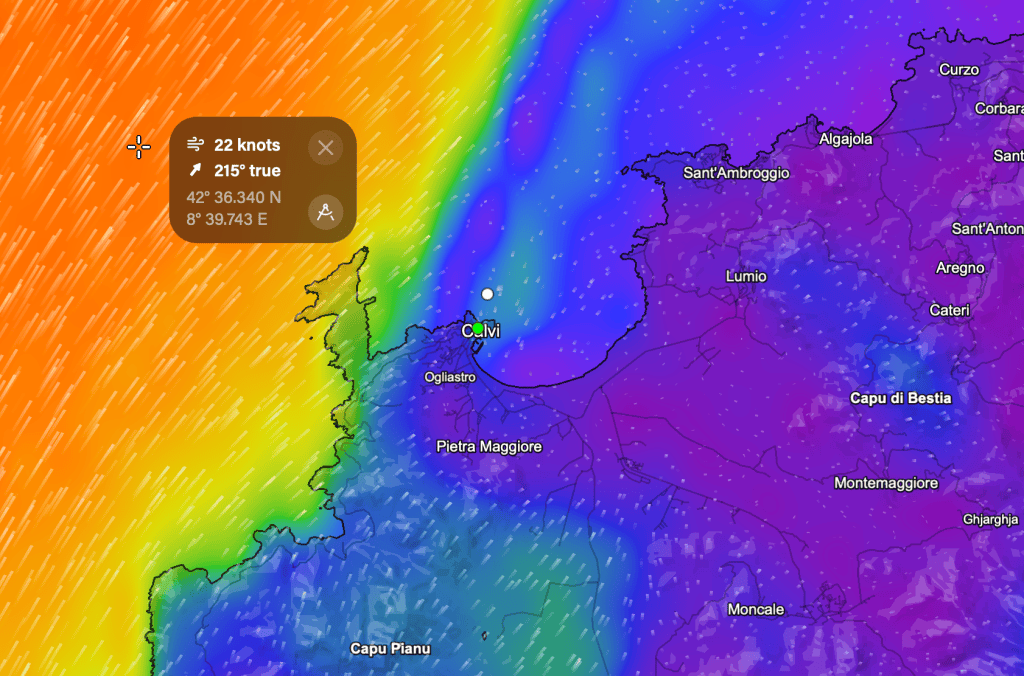
It’s 0700 local, 0500 UTC. Sarah and I are sitting on a mooring in Calvi, about 40 miles down the west coast of Corsica from the island’s northern tip. The dinghy is launched, the boat is squared away, and right now we’re trying to work out why neither of the two heads will run. There’s a strong southerly blowing across the bay and we’re not going anywhere today. The forecast that put us here called for a Mistral. A Mistral is a northwesterly. Both of those things are true at the same time, and it took me a while to figure out why.
And despite everything Mother Nature can dish out, and the boat chores, and the troubles that turn up on their own schedule, this place is absolutely beautiful.
Getting here
We left Cannes Monday morning at 1030 local, 0830 UTC, and motored two miles out to the Îles de Lérins, where we anchored between Sainte-Marguerite and Saint-Honorat. Off season, so there was room. In August you couldn’t buy a spot in there.
The plan on paper had us leaving Cannes in the late afternoon and running overnight to Calvi, about 100 nautical miles. It’s the one leg with no bailout. Once you’re committed you’re committed, for fifteen hours, in the dark. So we split it, slept at the Lérins, and left at 0430 local, 0230 UTC, the next morning.
Fifteen hours later we came into Calvi at sunset, 1934 local, 1734 UTC. Dead flat the entire way. No wind at all, and hot enough by 1000 local, 0800 UTC, that you couldn’t stand on deck barefoot. We motored every mile of it. Not much of a sailing story.
The flat water paid us back, though. Fin whales, dolphin and tuna feeding on the surface on and off the whole way across. The dolphin rode the bow wave. The whales came right up alongside to look us over. Purely amazing.
Then the wind showed up.
The wind that turns around
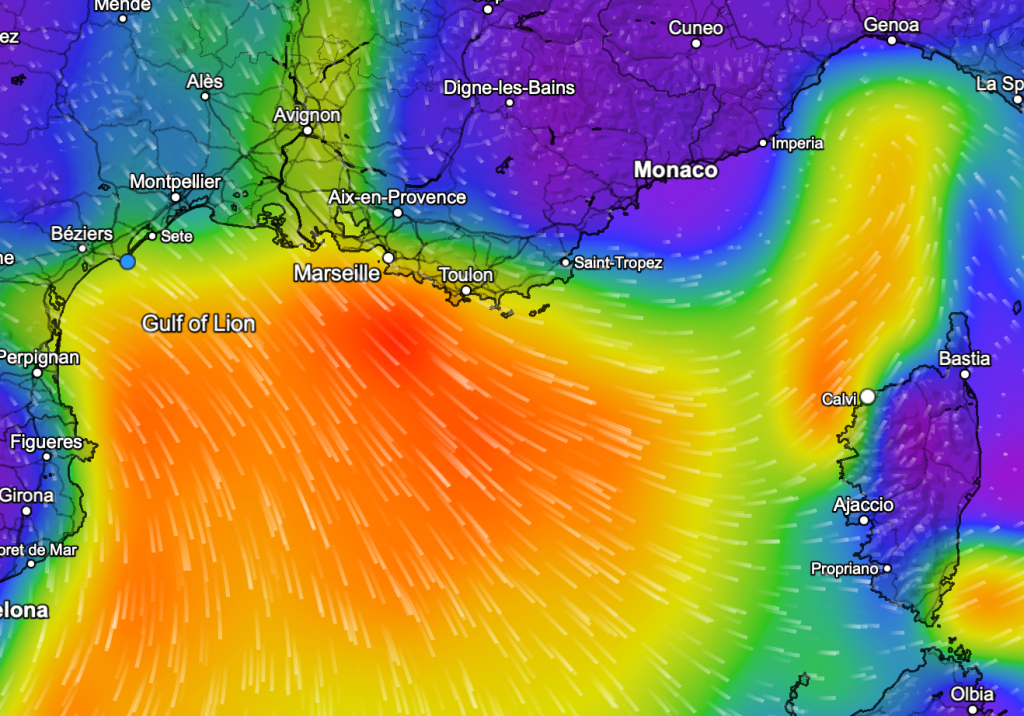
The Mistral is cold air draining down the Rhône valley and out over the Gulf of Lion, the big bite in the French coast between Marseille and Spain, heading east. Once it gets going it can hold for days.
Corsica is in the way, and Corsica isn’t a low green lump sitting in the water. It’s a mountain range with a coastline attached. The island runs 114 miles north to south and 52 across, so call it the length of Long Island and twice as wide, and Monte Cinto, the high point, is 8,878 feet. Mount Washington, which has an entire gift shop built on its reputation for wind, tops out at 6,288. Nothing east of the Mississippi gets above 6,684. Wind that hits something like Monte Cinto doesn’t climb over it. It goes around.
So the Mistral splits on Corsica. Half of it runs up the west coast and half runs down, and which half you get depends on where you’re sitting. We’re near the north end. We get the half running north. It arrives as a southerly.
A wind that left France going east reaches us going north. Same wind.
Naming the wind
Mistral comes from the Occitan of Languedoc and it means masterly. The master wind. Cross to Corsica or Italy and the same air is the maestrale, in Catalonia the mestral, in Malta the majjistral. Everybody around this basin looked at it and named it the boss. Provence is built around it, down to the village bell towers, which are open ironwork rather than stone so the wind goes through the tower instead of taking the tower with it.
The sayings are better than the architecture. It’s le vent qui rend fou, the wind that drives you mad. They say it will blow the ears off a donkey, or the horns off a bull, depending on who’s telling it. They call it mange-fange, mud-eater, because it dries the standing water and pulls the damp out of everything. My friend Bob’s version, and the one I’ll be using from now on, is that it’s strong enough to blow a dog off a chain.
Here in Calvi it isn’t even wearing its own name. The prevailing wind up here is the libeccio, out of the southwest, named for the direction of Libya.
What’s holding us on this mooring is the master wind in somebody else’s clothes.
Why the big models don’t see it
The global models work on a grid, and their squares are ten kilometers across or more. At that size an 8,800 foot mountain range gets smoothed into a gentle rise. The model looks at the Gulf of Lion, sees a Mistral, and puts a northwesterly over Corsica. Right about the system, useless for the bay we’re sitting in.
AROME is Météo-France’s high-resolution model and it runs on a grid of a little over a kilometer. At that size the mountain is still a mountain. Out here the difference isn’t a few knots, it’s the opposite direction, which is a different anchorage and a different day.
The catch is that AROME only reaches about two days out while the global models see ten. So AROME will tell you what tomorrow looks like in your actual bay and has nothing whatsoever to say about next Tuesday. You run both, the big models for the shape of the week and AROME to decide whether you actually leave in the morning.
What it cost us
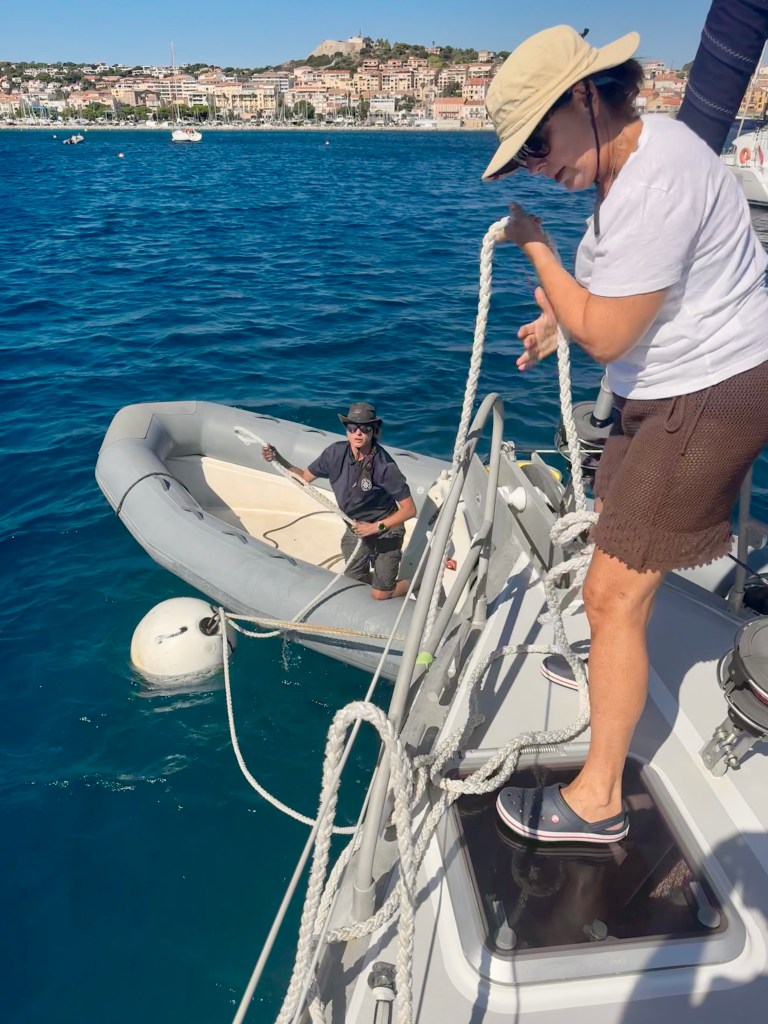
We anchored in the northeast corner of the bay when we came in, which is fine in flat water. The dinghy ride from there into town is over a mile, and with the southerly filling in that turns into a soaking. So we moved onto a mooring closer to town and gave up the anchorage.
One local note worth writing down, and it came straight from Amy, the agent de port who runs this mooring field. The anchors and chain hold wind perfectly well. What they don’t hold is chop, and a north wind pushes swell straight in. Her words: we don’t expect a northerly, but if one develops we will chase everyone off the moorings and you are on your own. She is confident, she is strong, and she means it. There’s no northerly coming while we’re here, so we stay.
The wild side
The west coast is the wild side of Corsica, and that’s not a turn of phrase. Between here and Ajaccio, the Gulf of Porto has been a UNESCO World Heritage site since 1983: the Calanche of Piana, the Gulf of Girolata, the Scandola reserve. Scandola is red porphyry standing straight out of clear water, cut through with islets and caves you can’t get into, sea eagles nesting on it. Girolata has no road, so you arrive by boat or on a mule track.
That’s what we came down this side for. It’s also why we’re sitting here. The same geology that makes this coast worth the trip is why there’s nowhere on it to hide. Cliffs and open gulfs don’t make harbors.
The part I’d underline
Out here it either blows or it doesn’t. There’s no useful middle, and anyone who learned to sail in ordinary weather takes a while to believe it. We motored 100 miles from the Lérins without enough wind to fill a shirt, and two days later we’re tied to a mooring because we can’t move. Same week, same water.
And a window isn’t just the wind dropping. We’re working south, so a southerly is dead on the nose. What we’re waiting for isn’t calm, it’s wind out of another quarter and a sea that’s had time to lie down. Those two never arrive together. Wind eases hours before the swell does, and 10 knots after three days of blow is still a forecast for a miserable day.
Ajaccio is 65 miles further down this coast, Napoleon’s birthplace and the biggest town on this side of the island, and we have friends landing there at 1735 local, 1535 UTC, on Saturday afternoon. Flights booked, hotel held. So we watch it, and if the wind lifts early enough we go.
Which leaves tomorrow. Two heads to tear apart, smell and all, exactly the way I remember it as a deckhand in the 1980s, and then most likely a trip ashore to hunt down parts. Outside there’s a southerly that isn’t supposed to be a southerly, a coast with nowhere to duck into, and some of the prettiest water either of us has ever seen, all at the same time. Somewhere out there a fin whale is still wondering what we’re doing out here. Fair question.
Fair winds from S/V Spindrift

 S/V Spindrift
Leave a comment